
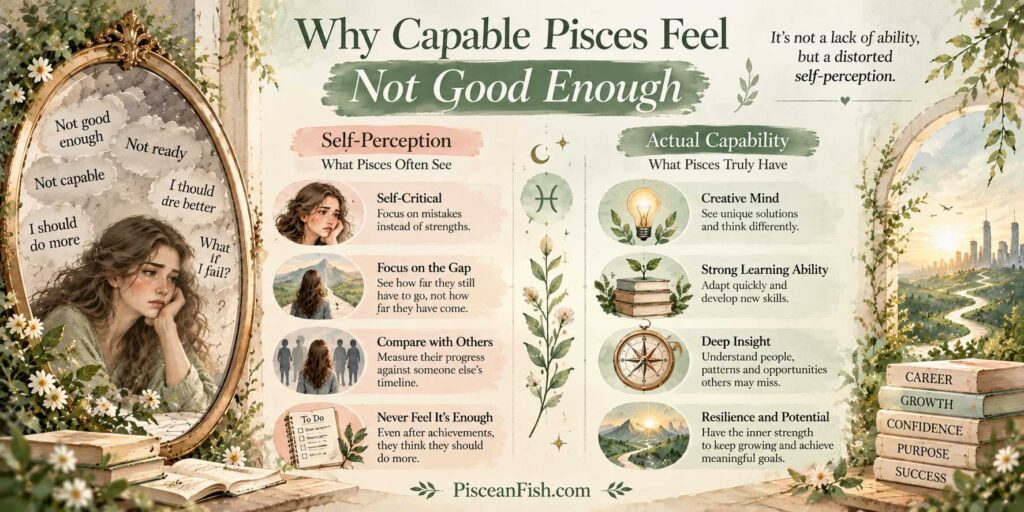
Pisces self-doubt can be confusing because it does not always match reality. A Pisces person may have genuine abilities, creative ideas, emotional intelligence, and strong potential, yet still wonder whether they are capable enough to achieve their career and life goals.
They may work hard but feel behind. They may have talent but hesitate to use it. They may accomplish something important but immediately focus on what they have not achieved yet. This creates a frustrating gap between actual capability and perceived capability. The problem is not necessarily a lack of ambition. In many cases, Pisces may have meaningful goals and a strong desire to build a life that feels purposeful.
However, their internal evaluation can become so critical that progress feels smaller than it really is. Instead of asking, “What have I accomplished?” they may focus on, “Why am I not further ahead?” Over time, this way of thinking can weaken confidence even when their abilities continue to grow.
Pisces Self-Doubt Can Make Progress Feel Invisible
One of the biggest reasons capable Pisces may feel inadequate is that they often measure themselves against their desired destination rather than their current progress. When someone has a strong vision for their future, the distance between the present and that vision can feel enormous. A Pisces may think about the career they want, the financial stability they hope to build, the skills they still need, or the person they want to become.
Consequently, instead of recognizing progress, they see the remaining distance. This can create a misleading conclusion: “If I have not reached my goal yet, perhaps I am not capable of reaching it.” But progress and completion are different things. Being halfway toward a meaningful goal does not mean you are failing. It means you are halfway there. A person’s current position should not automatically be treated as evidence of their ultimate potential.
The Gap Between Potential and Confidence
Some Pisces may possess considerable potential while having relatively low confidence in that potential. This can happen when a person has not yet accumulated enough evidence of their abilities through experience. Potential is often invisible before it is developed. You may know that you are creative, intelligent, adaptable, or capable of learning, but until those qualities produce consistent results, it can be difficult to trust them.
As a result, Pisces may underestimate themselves precisely when they are still developing. This is especially important when pursuing long-term goals. A career rarely develops in a perfectly straight line. Skills improve gradually. Opportunities appear unexpectedly. Plans change. Setbacks happen.
Therefore, confidence should not depend on having everything figured out. Instead, confidence can come from knowing that you are capable of learning, adapting, and continuing.
Why Career Comparison Can Intensify Feelings of Inadequacy
Career comparison is particularly damaging because professional progress is highly visible. People can easily compare their position with someone else Job title, Income, Business success, Education, Professional network, Skills, Achievements, Social recognition.
However, these comparisons rarely account for differences in circumstances, opportunities, timing, resources, priorities, or starting points. A Pisces may see someone moving ahead quickly and interpret that progress as proof that they are falling behind. Yet another person’s timeline cannot accurately predict your own.
Furthermore, people often compare their internal uncertainty with someone else external success. That is an unfair comparison. Someone can look highly confident professionally while privately struggling with uncertainty.
Likewise, someone who currently appears behind may be developing skills that become valuable later. Career development is not a race with one universal timetable.
Pisces May Set Goals Based on Meaning, Not Just Achievement
Another important factor is that Pisces are often associated with a desire for meaningful experiences and purposeful goals. For some Pisces, simply earning money or gaining status may not be enough. They may want their work to feel significant. They may want creativity, emotional satisfaction, independence, contribution, or personal meaning from what they do. This can make career decisions more complicated. A conventional path may appear successful from the outside but feel empty internally.
Consequently, a Pisces may take longer to decide what direction feels right. That uncertainty can sometimes be mistaken for lack of ambition. It is not necessarily a lack of ambition. It can be a search for alignment.
However, there is an important balance to maintain: searching for meaningful work should not become an excuse to remain permanently undecided. Purpose becomes more useful when it is connected to action.
The Danger of Waiting Until You Feel Ready
Self-doubt can encourage postponement. A Pisces may believe they need more confidence before applying for an opportunity, starting a project, learning a skill, changing direction, or pursuing an ambitious goal. But confidence often develops after action rather than before it. Waiting until every doubt disappears can therefore become a trap.
You may never feel completely ready for a major life decision. Instead, you can ask: “What is the next reasonable step I can take with the abilities I currently have?” That question is much more productive than: “Am I good enough to succeed?” The first question creates movement. The second can create endless evaluation.
Perfectionism Can Make Capable Pisces Feel Behind
Perfectionism can also contribute to Pisces self-doubt. A person may have high standards for their career, creativity, personal development, or future lifestyle. High standards can encourage growth, but they can become harmful when every imperfect result is interpreted as evidence of inadequacy. The internal standard may gradually become impossible. Do more. Improve faster. Make fewer mistakes. Be more confident. Reach the goal sooner.
Even genuine achievements then feel insufficient. The problem is not necessarily the ambition itself. The problem is using perfection as the minimum requirement for self-respect. A healthier approach is to maintain high standards while accepting gradual improvement. You can aim for excellence without requiring yourself to be flawless.
Pisces May Focus Too Much on What They Lack
Self-doubt often directs attention toward missing qualities. You may think: I need more confidence. I need better communication skills. I need more experience. I need more knowledge. I need more discipline. These observations may be partially true.
However, focusing exclusively on weaknesses creates an incomplete picture. Personal development should involve both improvement and recognition. Ask yourself, What am I already good at? Which abilities have I developed through experience? What problems can I solve today that I could not solve previously? Which strengths could become more valuable if I developed them further? These questions turn self-perception from criticism into assessment.
Hidden Strengths Can Become Career Assets
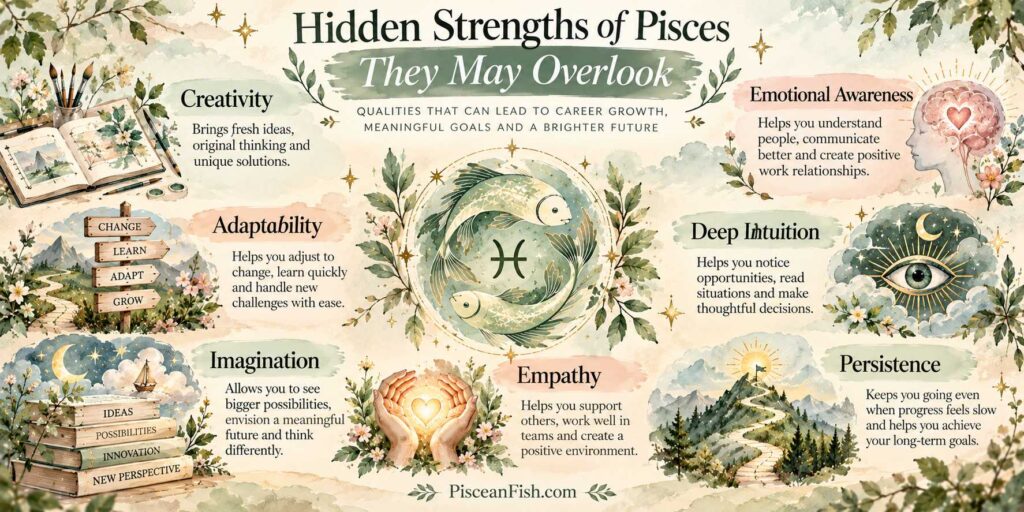
Some abilities may not initially appear impressive because they are difficult to measure. For example, emotional awareness can improve communication. Creativity can generate new approaches to problems. Adaptability can help someone navigate changing professional environments. Observation can reveal details others miss. Empathy can improve teamwork and leadership. Intuition, when combined with evidence and careful reasoning, can help someone notice patterns and possibilities. These qualities become especially valuable when developed alongside practical skills.
The goal is not to rely on personality alone. Instead, the goal is to transform natural tendencies into useful capabilities. For example, creativity becomes more powerful when combined with technical knowledge. Empathy becomes more valuable when combined with communication skills. Vision becomes more effective when combined with planning and execution. In this way, hidden strengths can become measurable professional advantages.
A Meaningful Goal Requires More Than Motivation
Another reason Pisces may feel inadequate is that they can place too much emphasis on motivation. When motivation is high, goals feel exciting. When motivation disappears, the goal can suddenly seem unrealistic.
However, long-term achievement depends on more than motivation. It requires consistency, learning, planning, patience, and the willingness to continue during periods when progress feels slow.
Therefore, instead of asking “Do I feel confident today?” ask “What can I consistently do even when confidence is low?” This shift is important. Confidence is an emotional state. Consistency is a behaviour. Your future is usually influenced more by repeated behaviour than by whether you feel confident every day.
Do Not Let One Setback Define Your Potential
Career and life goals inevitably involve setbacks. An unsuccessful application, business idea, examination, project, financial decision, or career change can feel deeply disappointing. For someone already struggling with self-doubt, however, one setback can become a larger judgment: “Maybe I am not capable.” That conclusion is too broad. A setback provides information about a particular attempt. It does not provide a complete measurement of your potential. Instead, evaluate the situation more precisely.
Pisces Need to Separate Self-Worth From Career Status
Career is important, but it should not become the sole measurement of personal worth. A job title can change. Income can fluctuate. Businesses can succeed and fail. Plans can change. Industries can disappear. Skills can become outdated. If self-worth depends entirely on professional success, every change becomes emotionally threatening.
A healthier perspective is: “My career is part of my identity, but it does not determine my entire value.” This actually creates stronger long-term confidence. When your identity is not completely dependent on achievement, setbacks become easier to evaluate objectively. You can acknowledge failure without believing that you are a failure.
Build Confidence Through Evidence
One of the most practical ways to reduce self-doubt is to stop relying entirely on feelings when evaluating your abilities. Create evidence. Track completed projects. Record skills you have learned. Keep positive professional feedback. Write down difficult situations you handled successfully. Review goals you once considered impossible but eventually achieved. Notice areas where your performance has improved. This creates a personal record of competence.
When self-doubt appears, you can return to evidence rather than allowing the strongest emotion of the moment to determine your self-perception. Confidence becomes less about telling yourself, “I am amazing,” and more about knowing: “I have evidence that I can learn, adapt, improve, and accomplish difficult things.” That is a much more stable form of confidence.

Focus on Your Direction, Not Someone Else Timeline
Every meaningful career or life goal has its own timeline. Some people find their direction early. Others change careers several times. Some build businesses quickly. Others spend years developing skills before their opportunity appears. Some achieve financial stability early. Others take a longer route. There is no single schedule that determines whether a person is successful.
Therefore, Pisces may benefit from replacing comparison with direction. Instead of asking: “Am I ahead of everyone else?” ask: “Am I moving toward the life I actually want?” That question brings attention back to personal priorities. Progress becomes easier to recognize when success is defined according to your own meaningful goals.
Your Sensitivity Does Not Cancel Your Capability
Your sensitivity should not automatically be interpreted as weakness. A sensitive person can still be disciplined. A reflective person can still be ambitious. A compassionate person can still be competitive. A creative person can still be highly strategic. An emotionally aware person can still make difficult decisions. There is no requirement to abandon sensitivity in order to become successful.
Instead, the goal is to develop structure around your strengths. Your imagination needs execution. Your ideas need planning. Your empathy needs boundaries. Your ambition needs consistency. Your intuition needs critical thinking.
When these qualities work together, sensitivity can become part of your capability rather than something you feel you must overcome.
Final Thoughts: Capability Is Not Always Visible From the Inside
Sometimes the biggest obstacle for a capable Pisces is not a lack of ability. It is an inaccurate perception of that ability. Pisces self-doubt can make unfinished goals look like failures, slow progress look like incompetence, and temporary uncertainty look like permanent limitation.
However, your current position does not necessarily represent your final potential. You can still be developing. You can still be learning. You can still be uncertain. And you can still be capable. The goal is not to eliminate every feeling of inadequacy.
Instead, learn to question it. When self-doubt says, “You are not good enough,” look for evidence. When comparison says, “You are behind,” return to your own direction. When perfectionism says, “This is not enough,” recognize the progress you have already made. And when fear tells you to wait until you feel completely ready, remember that capability is often built through action.
Your career and life goals do not require you to have perfect confidence from the beginning. They require you to keep developing the abilities you already possess. Sometimes, the next stage of growth is not becoming more capable. It is finally learning to recognize the capability that was already there.