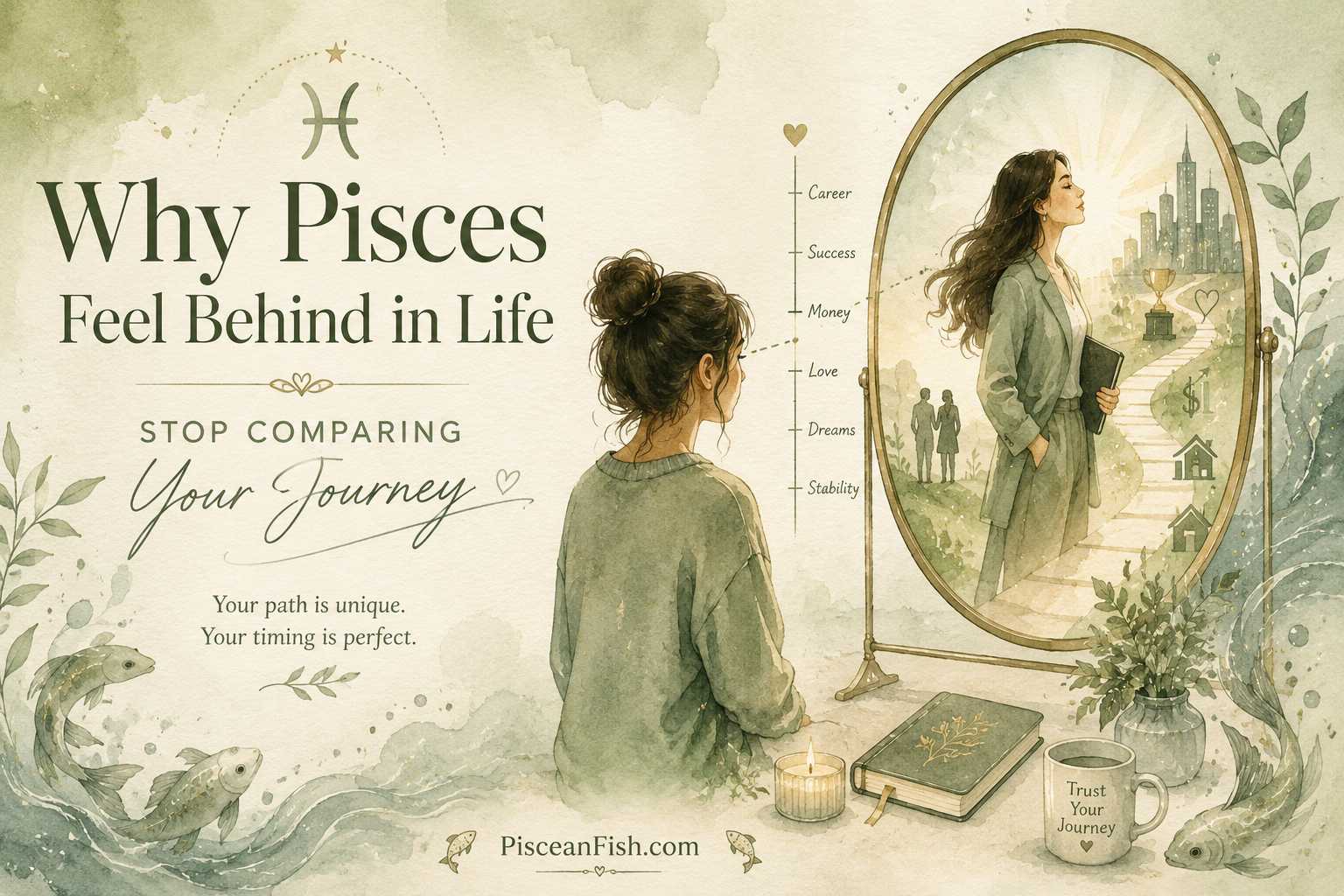
There are moments when Pisces feel behind in life, even when they are doing better than they realize. They may look around and see someone building a successful career, getting married, buying a home, traveling, or simply appearing confident about the future. Suddenly, their own progress can seem small. What once felt like a normal journey begins to feel like a race they are losing.
But what if you are not actually behind? What if you are simply looking at someone else chapter while judging yourself for not being on the same page? For an emotionally sensitive and deeply reflective Pisces, self-comparison can become more than a passing thought. It can quietly affect confidence, motivation, self-worth, and even the ability to appreciate the life already being built.
The good news is that comparison is not a permanent part of your identity. You can learn to recognize it, understand where it comes from, and gradually replace it with something healthier.
Why Pisces May Feel Behind in Life
Life rarely follows a straight line. However, it is easy to forget this when the people around you appear to be moving forward. You may see someone your age achieving something you have not achieved yet. Perhaps they have a better job, a stronger financial position, a relationship, a growing business, or a lifestyle that looks exciting from the outside. Then an uncomfortable question appears: “Why am I not there yet?” For Pisces, this question can become emotionally heavy because they may spend a great deal of time reflecting on their choices, dreams, mistakes, and future possibilities.
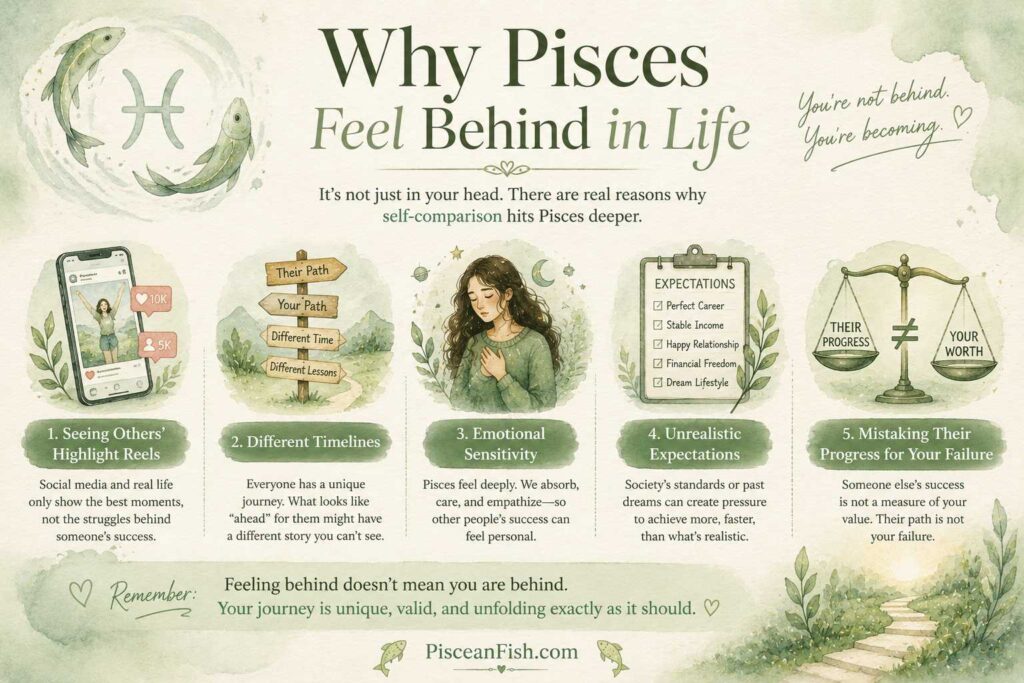
Instead of simply noticing another person’s achievement, they may internalize it. Someone else progress can start feeling like proof of their own lack of progress. But that conclusion is unfair. You are not seeing their entire story. You are seeing selected moments. Their success may have involved years of struggle, failures, uncertainty, support from others, financial advantages, or circumstances you know nothing about.
Therefore, comparing your complete reality with another person’s visible results will almost always make you feel inadequate.
When Someone Else Success Feels Like Your Failure
One of the most painful parts of self-comparison is the way the mind can change the meaning of another person’s success. There is nothing wrong with thinking: “I’m happy for them.” The problem begins when that thought changes into: “They are succeeding, so I must be failing.” Those two ideas are completely different.
Someone getting ahead does not mean you are falling behind. Someone finding love does not mean you are unlovable. Someone becoming financially successful does not mean your efforts are worthless. Someone discovering their purpose does not mean you have missed yours.
Most importantly, another person’s timeline is not a measurement of your value. Sometimes, the deepest pain comes from turning comparison into a judgment about who you are. You stop asking, “What do I want?” Instead, you start asking, “Why don’t I have what they have?” That shift can disconnect you from your own dreams.
How Social Media Can Intensify Self-Comparison
Social media can make this problem even stronger. Every day, you may see carefully selected images of people celebrating achievements, traveling, getting engaged, launching businesses, buying cars, improving their appearance, or enjoying seemingly perfect relationships.
Meanwhile, you are experiencing your entire life from the inside. You know your doubts. You know your unfinished plans. You know the mistakes you made. You know the nights when you questioned yourself. The other person may only show you their best moments. As a result, you compare your behind-the-scenes with someone else highlight reel. That is not a fair comparison.
Moreover, repeated exposure can gradually create the illusion that everyone is moving faster than you. Even when you logically understand that social media is selective, your emotions may still react to what you see.Therefore, one powerful step is to become more conscious of what triggers your comparison.
If certain accounts consistently leave you feeling inadequate, anxious, or unsuccessful, you do not have to keep consuming that content simply because everyone else does. Protecting your peace is not weakness. It is self-awareness.
The Emotional Cycle of Self-Comparison
Self-comparison often follows a predictable pattern. You notice someone else’s progress. You compare it with your own life. You conclude that you are behind. Your confidence decreases. You lose motivation. You take less action. You feel even further behind.This cycle can be particularly damaging because the original comparison may have been based on incomplete information. Yet the emotional reaction becomes real.
Eventually, you may begin avoiding opportunities because you believe you are already too late. That is where comparison becomes dangerous. It does not simply make you feel bad. It can influence your decisions. You might stop pursuing a dream because someone else reached it earlier. You might avoid starting something because you believe you should have started years ago. You might underestimate yourself because your progress does not look impressive enough.
However, being late according to someone else timeline does not mean you are late for your own life.

Comparison vs. Healthy Inspiration
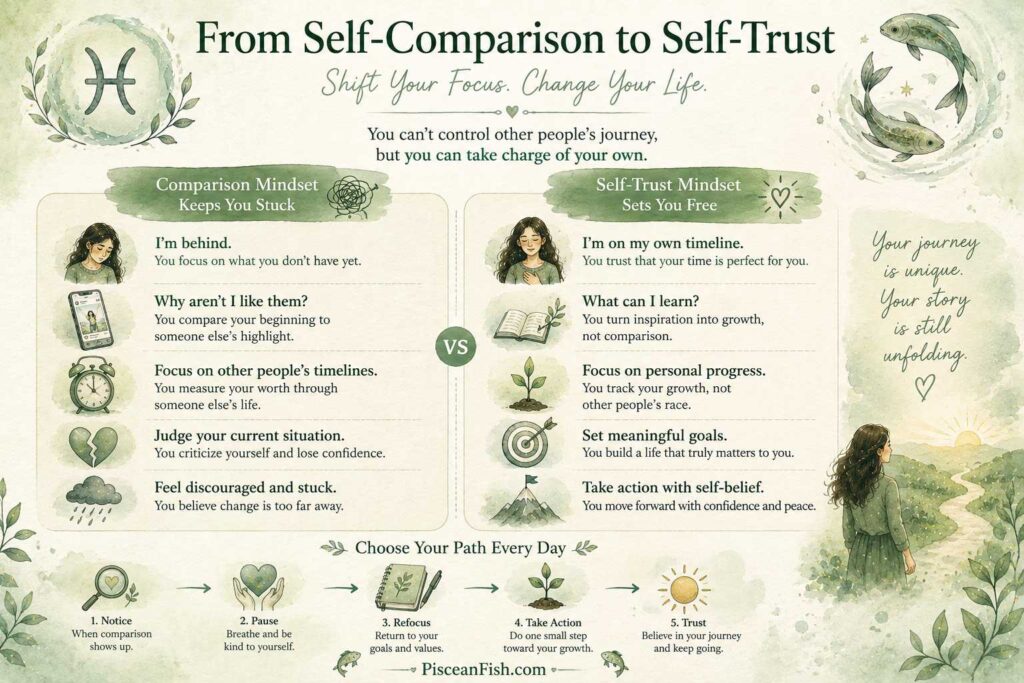
Not every comparison is harmful. Sometimes, seeing another person’s success can reveal something you genuinely want. The difference is how you respond. Unhealthy comparison says: “They are better than me.” Healthy inspiration says: “They achieved something meaningful. Perhaps I can learn from their journey.” Unhealthy comparison attacks your identity. Healthy inspiration gives you information. For example, if someone has built a successful career, you do not need to use their success as evidence that you have failed.
Instead, you can ask: “What qualities or habits helped them get there, and which of those could I develop?” Now comparison has become a learning opportunity. The goal is not to stop noticing other people. The goal is to stop using other people as a weapon against yourself.
Stop Living According to Someone Else Timeline
One of the most important lessons in personal growth is understanding that there is no universal schedule for life. Some people find their purpose early. Others discover it after years of uncertainty. Some become financially stable in their twenties. Others rebuild their lives in their thirties, forties, or later. Some find relationships quickly. Others spend years learning how to build a healthy relationship with themselves first.
Therefore, asking whether you are “on time” may not even be the right question. A better question is: “Am I moving in a direction that matters to me?” Your timeline may look different because your circumstances are different. Your responsibilities are different. Your experiences are different. Your lessons are different. Your definition of a meaningful life may also be different. You do not need to arrive at the same destination at the same age as everyone else.
Create Your Own Definition of Success
Self-comparison becomes weaker when you stop allowing other people to define what success should look like. Ask yourself, what kind of life actually makes me feel fulfilled? What do I want to improve this year? Which goals genuinely belong to me? What kind of person am I trying to become? What would make me proud of myself even if nobody else noticed?
Perhaps success for you is not simply earning more money. Maybe it is becoming emotionally stronger. Maybe it is developing discipline. Maybe it is healing from an old experience. Maybe it is creating meaningful work. Maybe it is becoming more spiritually grounded. Maybe it is finally having the courage to begin something you have postponed for years. These forms of progress may not receive likes, applause, or public recognition.They still matter.
8 Ways to Stop Self-Comparison
1. Identify Your Comparison Triggers
Notice when comparison appears most strongly. Is it after scrolling through social media? Talking to certain people? Thinking about your age? Looking at career achievements? Once you know the trigger, you can respond instead of automatically reacting.
2. Separate Facts From Feelings
Feeling behind does not prove that you are behind. Write down what you are actually doing, learning, building, or improving. You may discover that your emotional judgment is much harsher than reality.
3. Track Your Own Progress
Instead of measuring yourself against another person, compare your present self with your past self. Ask, “What can I do today that I couldn’t do a year ago?” Even small changes count.
4. Turn Envy Into Information
If someone else life makes you jealous, do not immediately shame yourself. Ask what the feeling is trying to reveal. Perhaps you want financial independence. Perhaps you want creative freedom. Perhaps you want companionship. The emotion may be pointing toward an unmet desire. Use that information constructively.
5. Limit Unhealthy Comparison
You do not have to completely disappear from social media. However, you can unfollow, mute, or reduce content that repeatedly damages your confidence. Your attention is valuable. Choose carefully where you place it.
6. Focus on One Next Step
When you feel behind, thinking about your entire future can become overwhelming. Instead, ask, “What is one meaningful thing I can do today?” One application. One lesson. One conversation. One hour of focused work. One healthy decision. Small steps become meaningful when repeated.
7. Practice Self-Compassion
Talk to yourself as you would talk to someone you genuinely care about. You would probably not tell a struggling friend, “You are a failure because someone else is ahead of you.” So do not use that language against yourself. Self-compassion does not remove responsibility. It gives you the emotional strength to keep moving.
8. Trust Your Own Timeline
This may be the hardest step. You may not know exactly when everything will come together. That uncertainty can be frightening. Still, you can choose to believe that your life does not need to match someone else schedule to have value. You are allowed to grow slowly. You are allowed to change direction. You are allowed to start again. You are allowed to become yourself at your own pace.
Your Life Is Not Late
Perhaps the most important thing to remember is that you cannot determine whether your life is behind simply by looking at someone else life. Their journey is theirs. Yours is yours. There will always be someone earning more, achieving earlier, traveling farther, looking more successful, or reaching a milestone before you. If you use every person’s progress as a measurement of your own worth, you will never feel like enough.
Instead, turn your attention inward. Look at how far you have already come. Look at the lessons you survived. Look at the qualities you have developed. Look at the things you are still trying to improve. Then ask yourself one simple question, “What is the next step for me?” You do not need to win someone else race. You do not need to prove that you are ahead. You simply need to keep building a life that feels meaningful to you.
Because sometimes, the moment you stop asking “Why am I behind?” is the moment you finally have enough peace to ask “Where do I want to go next?” And that question can change everything.