
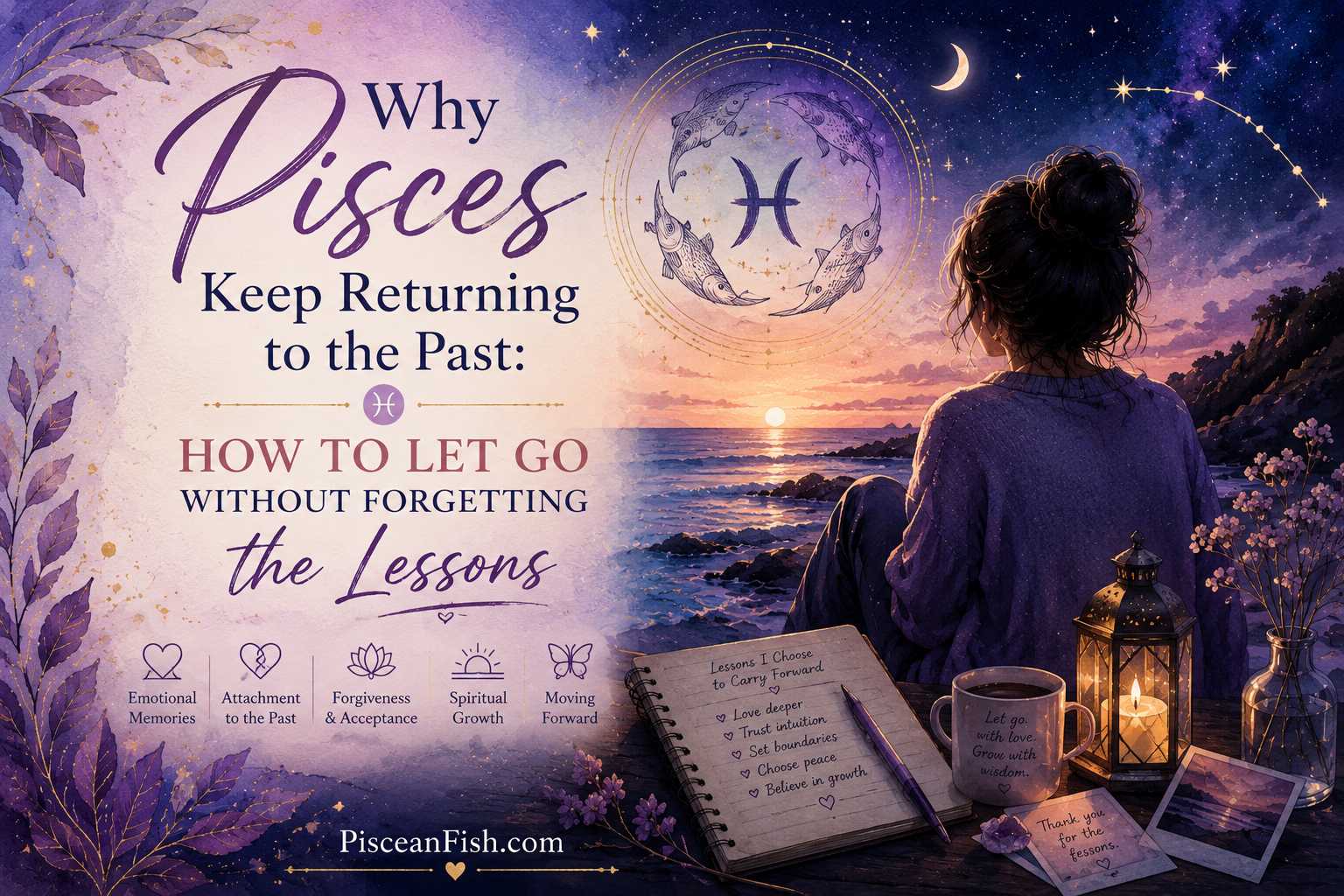
Some memories do not disappear when the moment ends.
A conversation from years ago can suddenly return to your mind. An old photograph can bring back emotions you thought you had already overcome. A familiar song, place, smell, or even a particular time of year can make the past feel surprisingly close again.
For people who strongly relate to Pisces traits, memories may carry more than facts about what happened.
They carry feelings.
You may remember the exact sadness of a goodbye, the comfort of an old friendship, the excitement of a particular stage of life, or the hope you once had for a relationship that did not work out.
As a result, letting go of the past can become difficult.
You may understand logically that life has moved forward. However, emotionally, a part of you may continue returning to people, experiences, and possibilities that no longer exist in the same way.
There is nothing wrong with remembering meaningful experiences.
Your past helped shape the person you are today.
However, problems can develop when remembering becomes emotional attachment and reflection becomes a refusal to accept the present.
Moving forward does not require you to erase your memories.
Instead, emotional growth means learning how to carry the lessons of the past without continuing to live inside it.
Why Do Pisces Keep Returning to the Past?
Pisces are commonly associated with emotional depth, imagination, sensitivity, and reflection.
Because of these qualities, experiences may leave powerful emotional impressions.
Some people remember what happened.
However, emotionally sensitive people often remember how it felt.
You may remember the exact atmosphere of a moment.
You may recall what you hoped would happen next.
Moreover, you may continue thinking about what could have happened if circumstances had been different.
This emotional connection can make the past feel alive long after an experience has ended.
Therefore, when you return to an old memory, you may not simply be remembering an event.
You may be emotionally experiencing part of it again.
Understanding this difference is important because it explains why simply telling yourself to “forget about it” rarely works.
Emotional memories often need understanding, acceptance, and time.
Emotional Memories Can Feel Stronger Than Reality
Memory is powerful. However, we do not always remember experiences exactly as they happened.
Over time, our emotions, imagination, and current circumstances can influence the way we view the past.
For example, imagine you are currently feeling lonely.
Suddenly, you begin remembering an old relationship.
You remember the happy conversations.
You remember feeling loved.
You remember the beautiful moments.
However, you may temporarily forget the disagreements, disappointments, confusion, and reasons the relationship ended.
As a result, the past begins to look better than the present.
This is one reason emotionally sensitive people may struggle to let go.
Sometimes, you are not attached to the complete reality of the past.
You are attached to a carefully selected emotional version of it.
The Danger of Idealizing the Past
Idealizing the past means remembering experiences as better, happier, or more perfect than they actually were.
This can happen with relationships, friendships, jobs, opportunities, or entire periods of life.
You may think:
“I was happier back then.”
“That person was the only one who truly understood me.”
“I will never experience anything like that again.”
“If I had made a different decision, everything would be better now.”
These thoughts can create emotional attachment.
However, they may not represent the full truth.
The past probably included both beautiful and difficult experiences.
Therefore, when you find yourself idealizing an old situation, try to remember the complete picture.
Ask yourself:
“What was beautiful about that experience?”
“What was difficult?”
“What did I repeatedly ignore?”
“Why did that chapter eventually end?”
Remembering honestly does not mean destroying your good memories.
Instead, it prevents nostalgia from becoming an emotional prison.
Are You Missing the Person or the Feeling?
This can be a powerful question when you are struggling to release an old relationship or friendship.
Sometimes, you believe that you miss a particular person.
However, what you actually miss may be the feeling associated with them.
Perhaps you miss feeling understood.
You may miss companionship.
Maybe you miss having someone to talk to every day.
Perhaps you miss the version of yourself that existed during that stage of life.
Understanding this difference can create emotional clarity.
If you miss feeling understood, you can build new relationships based on emotional connection.
If you miss companionship, you can create opportunities to connect with others.
If you miss who you used to be, you can ask which qualities from that version of yourself you want to rediscover.
The past can reveal what you need without becoming the only place where you believe those needs can be fulfilled.
Why Unfinished Emotional Stories Are Difficult to Release
Sometimes, people return to the past because they never received closure.
A relationship may have ended suddenly.
Someone may have disappeared without explaining why.
Perhaps you never had the opportunity to say what you truly felt.
As a result, your mind continues searching for answers.
You replay conversations.
You imagine different outcomes.
You think about what you should have said.
Moreover, you may create imaginary conversations in which you finally receive the explanation, apology, or understanding you wanted.
However, closure does not always come from another person.
Sometimes, the person who hurt you cannot or will not provide the answers you need.
Waiting for them to give you emotional peace can keep you connected to the past.
Therefore, you may need to create your own closure.
Accept That Some Questions Will Remain Unanswered
Acceptance can be difficult because the human mind naturally wants explanations.
We want to know why people changed.
Why relationships ended.
Why opportunities disappeared.
Why something painful happened despite our best efforts.
However, life does not always provide satisfying answers.
Sometimes, the explanation you receive creates even more questions.
Therefore, emotional freedom may require accepting uncertainty.
You can say:
“I may never fully understand why this happened, but I accept that it happened.”
This does not mean that you approve of what happened.
Acceptance simply means that you stop fighting with reality.
You recognize that the past cannot be rewritten.
Once you stop using your energy to argue with what has already happened, you can begin using that energy to build what comes next.
Letting Go Does Not Mean Forgetting
Many people resist letting go because they believe it means forgetting.
They worry that moving forward will make an important person, relationship, or experience meaningless.
However, letting go and forgetting are completely different.
Forgetting means losing the memory.
Letting go means changing your relationship with the memory.
You can remember someone without waiting for them to return.
You can appreciate a beautiful experience without trying to recreate it.
You can acknowledge pain without allowing it to control every future decision.
Moreover, you can carry the lesson without carrying the emotional burden forever.
The goal is not to erase your history.
The goal is to stop allowing your history to control your present.
Understand What the Past Is Trying to Teach You
Instead of repeatedly asking, “Why did this happen to me?” consider asking:
“What can this experience teach me?”
Perhaps an old relationship taught you the importance of boundaries.
Maybe a disappointment taught you not to ignore your intuition.
A failure may have revealed strengths you did not know you had.
Similarly, losing someone may have taught you to appreciate meaningful relationships while they are present.
Every difficult experience does not automatically contain a simple or obvious lesson.
However, reflection can help you discover meaning.When you find the lesson, the memory can begin to change.It becomes less about what you lost and more about what you learned.
Forgiveness Can Help You Release Emotional Weight
Forgiveness is often misunderstood.
Some people believe forgiving means saying that harmful behavior was acceptable.
Others think forgiveness requires rebuilding a relationship with the person who hurt them.
However, forgiveness does not always mean reconciliation.
You can forgive someone and still maintain distance.
You can release anger while keeping healthy boundaries.
Moreover, you can choose peace without allowing the same behavior back into your life.
Forgiveness can be a personal decision to stop carrying emotional pain every day.
Holding resentment may create the illusion that you are protecting yourself.
However, constantly remembering the injury can keep you emotionally connected to the person or experience that caused it.
Forgiveness does not change the past.
It changes how much power the past continues to have over your present.
Do Not Forget to Forgive Yourself
Sometimes, the person you struggle most to forgive is yourself.
You may think:
“I should have known better.”
“Why did I stay so long?”
“Why did I trust that person?”
“I wasted so much time.”
“If I had made a different choice, my life would be better.”
Self-blame can keep you trapped in the past just as strongly as resentment toward another person.
However, you made your past decisions with the knowledge, emotions, and circumstances you had at that time.
Today, you may see the situation differently because you have grown.
Therefore, instead of judging your past self entirely through the wisdom you have now, practice compassion.
Recognize the mistake.
Learn from it.
Take responsibility when necessary.
Then allow yourself to grow beyond it.
Stop Visiting the Past Looking for a Different Ending
One of the most exhausting emotional habits is repeatedly returning to an old experience and imagining how it could have ended differently.
“What if I had said something else?”
“What if I had stayed?”
“What if I had left earlier?”
“What if they came back?”
These thoughts may feel productive, but often they simply keep you emotionally attached.
Reflection is helpful when it produces understanding.
Rumination becomes harmful when you repeatedly ask the same questions without discovering anything new.
Therefore, when you notice yourself replaying an old situation, ask:
“Am I learning something from this memory, or am I simply reopening the same emotional wound?”
The answer can help you decide whether it is time to redirect your attention.
Remove the Habits That Keep You Emotionally Attached
Sometimes, you want to move forward while continuing habits that constantly pull you backward.
You repeatedly check an old partner’s social media.
You reread conversations.
You look at photographs every night.
You constantly visit places connected with a particular memory.
You ask mutual friends for updates.
These behaviors may provide temporary emotional comfort.
However, they can also prevent emotional distance from developing.
You do not necessarily need to destroy every photograph or remove every reminder.
Instead, become aware of how your habits affect your healing.
Ask yourself:
“Does this action help me understand and accept the past, or does it keep me emotionally trapped there?”
Sometimes, moving forward requires creating practical distance before emotional distance can develop.
Create New Experiences Instead of Only Fighting Old Memories
Trying not to think about the past can sometimes make you think about it even more.
Therefore, moving forward should not focus entirely on removing old memories.
It should also involve creating new ones.
Try something different.Visit a new place.
Learn a skill.
Develop a healthier routine.
Strengthen meaningful relationships.
Create new personal goals.
When your present life becomes emotionally meaningful, the past may gradually become less powerful.
You are not replacing important memories.
Instead, you are reminding yourself that meaningful experiences are still possible.
Your best moments do not all have to exist behind you.
Use Spiritual Reflection to Find Meaning and Acceptance
For people who connect with spirituality, reflection can provide comfort during the process of letting go.
Prayer, meditation, gratitude, journaling, or quiet contemplation can create space to explore difficult emotions.
Spiritual growth often involves accepting that not everything happens according to our preferred timing or expectations.
Some experiences end before we feel ready.Some people leave.
Some opportunities disappear.
However, the ending of one chapter does not necessarily mean the end of growth, meaning, or hope.
Sometimes, moving forward requires trusting that life can still contain purpose beyond what you have lost.
Spiritual reflection can help shift your attention from:
“Why was this taken from me?” toward: “What kind of person can I become because of what I have learned?”
Allow Grief to Take Its Natural Time
Moving forward does not happen according to a perfect schedule.
Some experiences take longer to process than others.
Therefore, do not force yourself to “get over” something simply because other people think enough time has passed.
At the same time, be careful not to use emotional sensitivity as a reason to remain permanently attached to pain.
Healing requires patience, but it also requires movement.
Even small steps matter.
A day when you think about the memory less often is progress.
A moment when you remember without feeling overwhelmed is progress.
Choosing not to reopen an old wound is progress.Healing is rarely dramatic.
Often, it happens quietly.
Build a Present You Do Not Constantly Need to Escape From
Sometimes, people become overly attached to the past because they feel disconnected from their current life.
If your present feels empty, uncertain, or emotionally unsatisfying, old memories may become an escape.
Therefore, one of the most effective ways to move forward is to become more involved in your current life.
Ask yourself:
“What needs attention in my life right now?”
“What am I avoiding?”
“What would make my present more meaningful?”
“What small change can I make today?”
You cannot change yesterday.
However, you can influence what you do with today.
The more attention you give to building your present, the less emotional energy remains available for endlessly reliving the past.
Turn Your Past Into Wisdom Instead of a Permanent Home
Your past is part of your story.
It contains people you loved, mistakes you made, dreams you followed, disappointments you survived, and lessons you learned.
You do not need to hate the past to move beyond it.
You do not need to pretend that painful experiences never happened.
Moreover, you do not need to erase meaningful memories.
Instead, allow your past to become a teacher.
Visit it when you need wisdom.
Remember it when you need perspective.
Appreciate the moments that helped shape you.
However, do not build your permanent home there.
Your life is still happening in the present.
Final Thoughts: Carry the Lessons, Not the Weight
For people who relate strongly to Pisces traits, letting go of the past can be especially difficult because memories may remain emotionally powerful.
You may remember deeply.
You may imagine different endings.
You may continue caring about people long after relationships have changed.
However, moving forward does not require you to become emotionally cold or forget what mattered.
It requires acceptance.
Accept what happened.
Forgive when you are ready.
Learn what the experience can teach you.
Create healthy distance from habits that keep reopening old wounds.
Most importantly, begin building a present that deserves your emotional attention.
Your memories can remain part of you without controlling you.
Your past can guide you without becoming your destination.
You can appreciate what was, accept what is, and remain open to what may still come.
Because the purpose of healing is not to forget your story.
It is to carry its wisdom forward without carrying its weight forever.