

Have you ever entered a room feeling completely fine, only to leave feeling emotionally exhausted?
Perhaps you spoke with someone who was worried, angry, or deeply upset. Although their problem had nothing to do with you, their emotions seemed to stay with you long after the conversation ended.
You continued thinking about their situation.
You wondered whether they were okay.
Perhaps their sadness even began to affect your own mood.
For people who strongly relate to Pisces traits, experiences like these may feel familiar. Pisces are often associated with emotional sensitivity, compassion, intuition, and empathy. These qualities can create a remarkable ability to understand the feelings of others.
However, emotional sensitivity can also become overwhelming when you struggle to separate another person’s feelings from your own.
There is an important difference between understanding someone’s pain and carrying that pain with you.
You can care deeply without becoming emotionally responsible for everyone around you. Moreover, you can protect your inner peace without losing the empathy that makes you compassionate.
The goal is not to feel less.
Instead, the goal is to learn how to feel deeply without allowing every emotion around you to enter and control your inner world.
Why Do Pisces Absorb Other People’s Emotions?
Some people can listen to another person’s problems and emotionally move on shortly afterward.
However, emotionally sensitive individuals may have a very different experience.
You may not simply hear what another person is saying. Instead, you notice their voice, facial expressions, body language, silence, and changes in mood.
Sometimes, you may even begin imagining exactly what they are experiencing.
As a result, the emotional distance between their experience and your own begins to disappear.
If someone is sad, you may become sad.
If someone is anxious, you may begin feeling restless.
Similarly, spending time around constant negativity may leave you emotionally exhausted without immediately understanding why.
This does not necessarily mean that something is wrong with your sensitivity. However, it may indicate that you need stronger emotional boundaries.
Empathy becomes exhausting when you cannot recognize where another person’s emotional experience ends and your own begins.
Understanding the Difference Between Empathy and Emotional Absorption
Empathy means recognizing and understanding another person’s emotions.
Emotional absorption happens when those emotions begin affecting your own mental and emotional state.
Imagine that a close friend tells you about a difficult situation.
Empathy allows you to listen, understand their feelings, and offer appropriate support.
However, emotional absorption may cause you to continue thinking about the situation for hours or even days.
You may feel guilty for being happy while they are struggling.Perhaps you repeatedly imagine their pain.
Eventually, you may begin feeling as emotionally overwhelmed as the person who originally experienced the problem.
This is where empathy can become unhealthy.
Supporting someone does not require you to experience their suffering as if it were your own.
In fact, remaining emotionally balanced may allow you to provide better support.
Why Carrying Everyone’s Problems Becomes Emotionally Exhausting
Emotionally sensitive people sometimes become the person everyone approaches with their problems.
Friends may call when they are struggling.
Family members may share their worries.
Coworkers may discuss their frustrations.
Because you listen patiently and respond compassionately, people may feel emotionally safe around you.
This can be a beautiful quality.
However, constantly becoming an emotional container for other people can become exhausting.
Every difficult conversation requires mental and emotional energy.
If you repeatedly receive other people’s worries without allowing yourself enough time to recover, emotional overload may slowly develop.
The problem is that emotional exhaustion does not always appear immediately.
Instead, it may gradually affect your mood, thoughts, motivation, and inner peace.
Therefore, recognizing emotional overload is an important part of protecting yourself.
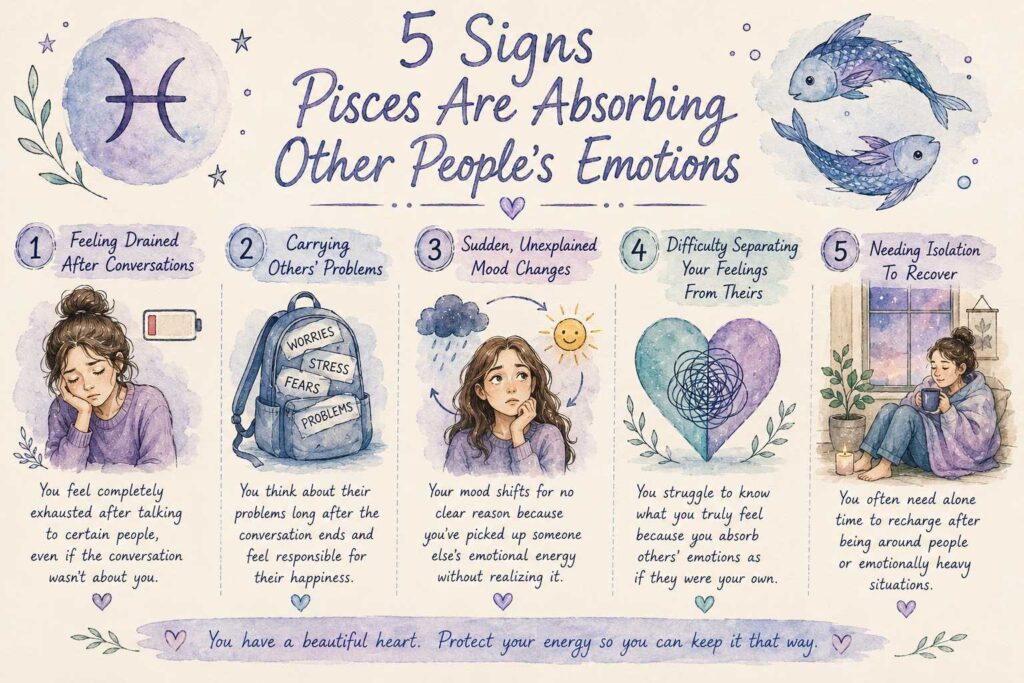
Signs You May Be Experiencing Emotional Overload
Emotional overload can appear differently for everyone.
However, one common sign is feeling exhausted after spending time with certain people.
You may enter a conversation feeling peaceful but leave feeling mentally heavy.
Another sign is constantly thinking about other people’s problems.
Even when you are trying to rest, your mind may continue replaying conversations and imagining possible outcomes.
Moreover, you may begin avoiding social interactions because you no longer have enough emotional energy to listen to anyone else.
You might also experience irritability.
Small problems that normally would not bother you may suddenly feel overwhelming.
In addition, you may struggle to identify your own emotions.
You know that you feel sad, anxious, or mentally exhausted, but you are not sure why.
When this happens, it may be time to ask yourself an important question:
“Is this emotion actually mine?”
Ask Yourself: Is This Emotion Mine?
This simple question can become a powerful emotional awareness practice.
Imagine that your mood suddenly changes after talking to someone.
Instead of immediately becoming lost in the emotion, stop and become curious about what happened.
Ask yourself:
“How was I feeling before this conversation?”
“When did my mood begin to change?”
“Is there something happening in my own life that explains this feeling?”
“Am I carrying an emotion that belongs to someone else?”
These questions can help you create emotional separation.
Of course, emotions are complicated, and you may not always find an immediate answer.
However, developing the habit of observing your emotions can improve self-awareness.
Over time, you may become better at recognizing which feelings come from your own experiences and which ones appear after absorbing the emotional atmosphere around you.
You Can Care Without Carrying
One of the most important lessons for emotionally sensitive Pisces is understanding the difference between caring and carrying.
Caring means:
“I understand that you are struggling, and I want to support you.”
Carrying means:
“Your struggle has now become my emotional responsibility.”
These are not the same thing.
You can listen to someone without spending the rest of the day worrying about them.
You can offer advice without feeling responsible for whether they follow it.
You can love someone without solving every problem in their life.
Most importantly, you can feel compassion without sacrificing your emotional wellbeing.
This does not make your empathy weaker.
Instead, it makes your empathy healthier.
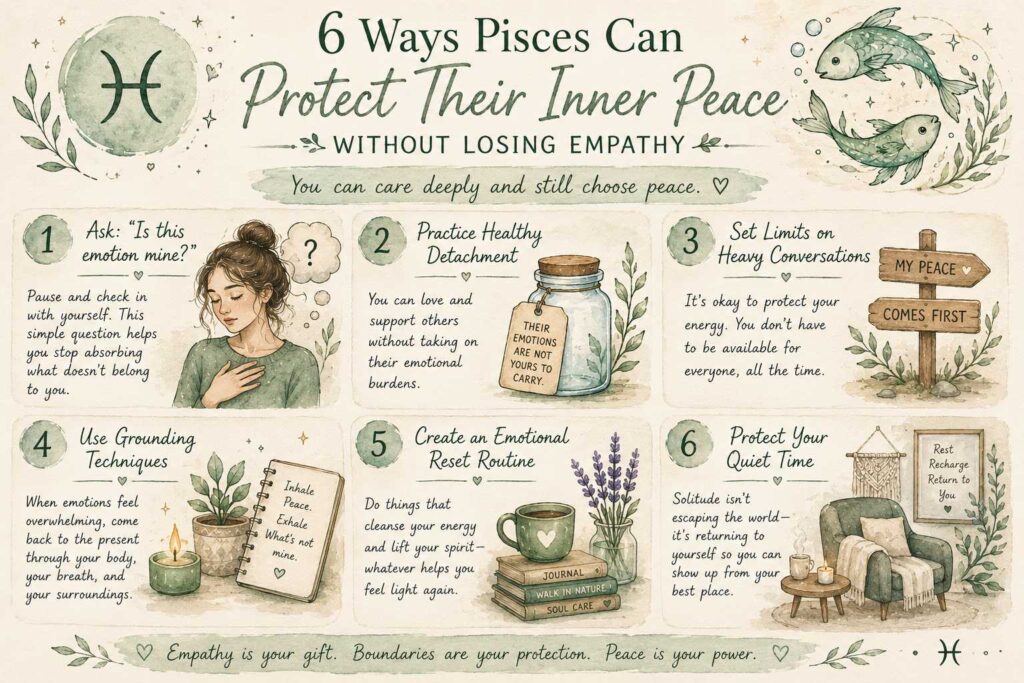
Healthy Detachment Does Not Mean Becoming Cold
The word “detachment” can sound negative.
You may imagine becoming emotionally distant, uncaring, or unavailable.
However, healthy detachment means something very different.
It means allowing other people to experience their own emotions without believing that you must control, fix, or carry those emotions.
For example, imagine someone you care about is going through a difficult experience.
You can listen.
You can offer encouragement.
You can help when appropriate.
However, after doing what you reasonably can, you allow yourself to return to your own emotional life.
You accept that some problems belong to other people.
This is healthy detachment.
You are not abandoning anyone.
You are simply recognizing the limits of your responsibility.
Stop Trying to Fix Every Problem
Empathetic people sometimes believe that listening is not enough.
When someone shares a problem, you may immediately begin searching for solutions.
You want to remove their sadness.
You want to make everything better.
However, not every problem can be solved by you.
Moreover, some people are not looking for solutions. They simply want to express their emotions.
Before taking responsibility for someone’s situation, consider asking:
“Do you want advice, or would you prefer me to simply listen?”This question can protect your emotional energy.
It prevents you from automatically becoming responsible for finding solutions.
Sometimes, being present is enough.
Create Boundaries Around Emotionally Heavy Conversations
Emotional boundaries are not only about saying no.
They can also involve deciding when, where, and for how long you are available for emotionally intense conversations.
For example, you may not have enough emotional energy for a long, difficult conversation late at night.
You may need quiet time after a stressful day.
Perhaps you are already dealing with personal challenges and cannot emotionally support another person at that moment.
It is acceptable to recognize these limits.
You can say:
“I care about what you’re going through, but I don’t have enough emotional energy for this conversation right now.”
Or:
“Can we talk about this tomorrow when I can give you more attention?”
Setting these boundaries allows you to offer support more genuinely instead of listening while feeling emotionally exhausted.
Be Careful Around Constant Negativity
Everyone experiences difficult periods in life.
Therefore, supporting people during challenging times is a normal part of meaningful relationships.
However, there is a difference between someone experiencing temporary difficulties and someone who constantly brings negativity into every interaction.
Some conversations repeatedly revolve around complaints, criticism, conflict, and hopelessness.
If you are emotionally sensitive, spending too much time in this environment may affect your inner state.
You do not necessarily need to remove every negative person from your life.
Instead, become more conscious of how different interactions affect you.
Ask yourself:
“How do I usually feel after spending time with this person?”
The answer can reveal where stronger emotional boundaries may be necessary.
Ground Yourself in the Present Moment
When you absorb other people’s emotions, your mind can become filled with thoughts, worries, and imagined situations.
Grounding techniques can help bring your attention back to the present.
One simple method is to focus on your physical surroundings.
Notice what you can see.
Pay attention to the sounds around you.
Feel your feet touching the ground.
Take slow breaths and observe the physical sensation of breathing.
You can also spend time outdoors, take a quiet walk, write in a journal, pray, or sit peacefully without digital distractions.
The purpose of grounding is not to escape emotions.
Instead, it helps remind your mind that you are here, in your own life, in the present moment.
Create a Personal Emotional Reset Routine
After an emotionally difficult conversation, you may need time to mentally reset.
Everyone’s routine will look different.
You might take a shower, go for a walk, listen to peaceful music, pray, journal, exercise, or simply spend a few minutes alone.
The activity itself is less important than the intention behind it.
Your emotional reset routine creates a transition between another person’s emotional experience and your own life.
Without this transition, you may carry the emotional energy of difficult conversations throughout the rest of your day.Therefore, create a simple routine that tells your mind:
“I have listened. I have cared. Now I am returning to myself.”
Protect Your Quiet Time
Emotionally sensitive people often need periods of quiet to process their experiences.
However, modern life can make genuine quiet difficult to find.
Messages, social media, news, conversations, and responsibilities constantly demand attention.
As a result, your mind may never receive enough time to recover.
Protecting quiet time does not necessarily mean spending hours alone.
Even twenty minutes without conversations, notifications, or responsibilities can help you reconnect with yourself.
During this time, avoid filling every moment with more information.
Allow yourself to simply exist without absorbing anything from anyone else.
Do Not Feel Guilty for Protecting Your Peace
Some Pisces may feel guilty when they begin creating emotional distance.
You may worry that you are becoming selfish.
Perhaps you think:
“What if they need me?”
“What if nobody else listens to them?”
“What if protecting myself means I am no longer compassionate?”
However, protecting your inner peace does not mean you have stopped caring.
You cannot continuously offer emotional support when you are mentally exhausted.
Moreover, ignoring your own needs may eventually lead to frustration, resentment, and emotional withdrawal.
Healthy self-protection allows compassion to remain genuine.
You help because you choose to, not because you feel emotionally trapped.
Build an Inner World That Belongs to You
When you constantly absorb the emotions of others, your inner world can become crowded.
Other people’s worries enter your thoughts.
Their problems affect your mood.
Their expectations influence your decisions.
Therefore, protecting your inner peace also means creating a stronger connection with yourself.
Ask yourself regularly:
“What am I feeling?”
“What do I need?”
“What is important to me right now?”
“What brings me peace?”
Journaling can be particularly helpful for exploring these questions.
Moreover, spiritual reflection, prayer, creative activities, and quiet time can help you reconnect with your own values and emotions.
The stronger your connection with yourself becomes, the easier it may be to recognize when you are carrying something that does not belong to you.
Turn Empathy Into a Strength Instead of an Emotional Burden
Empathy is not something you need to remove from your personality.
The world needs people who listen.
It needs people who care.
Moreover, genuine compassion can create meaningful relationships and deeper human connections.
However, empathy needs boundaries.
Without boundaries, compassion can become exhaustion.
Without emotional awareness, sensitivity can become overload.
Without healthy detachment, caring can become carrying.
Therefore, the goal is not to build walls around your emotions.
Instead, imagine creating a door.
You decide what enters.
You decide how long it stays.
Most importantly, you learn when it is time to let it leave.
Final Thoughts: Protect Your Peace Without Losing Your Heart
For people who relate strongly to Pisces traits, emotional sensitivity can feel like both a gift and a challenge.
You may understand people deeply.
You may recognize emotions that others overlook.
Moreover, your compassion may make people feel heard, understood, and supported.
However, you do not need to carry every emotion you encounter.
Learn to ask whether a feeling truly belongs to you. Create boundaries around emotionally exhausting conversations.
Practice healthy detachment.
Use grounding techniques to return to the present moment.
Most importantly, remember that you can care without carrying.
Protecting your inner peace does not require you to become less empathetic.
Instead, it allows your empathy to exist in a healthier and more balanced way.
Your sensitivity can remain a beautiful part of who you are.
However, not every sadness is yours to hold, not every problem is yours to solve, and not every emotional burden is yours to carry.
Sometimes, the healthiest thing you can do is offer compassion, release what does not belong to you, and gently return to your own inner peace.