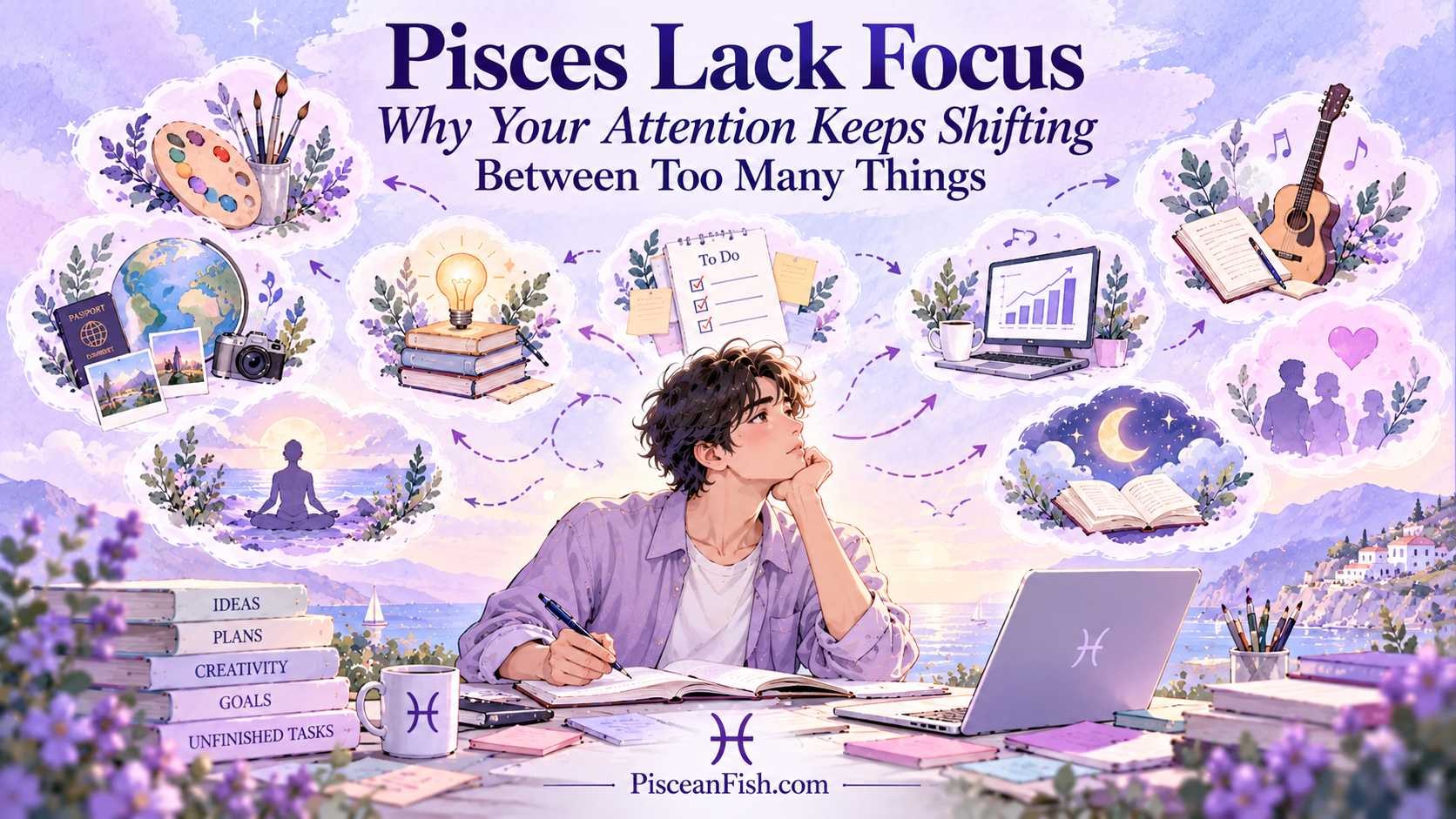
The phrase Pisces lack focus often brings to mind someone who gets distracted easily, struggles to complete tasks, or constantly moves from one interest to another.
However, the experience can be more complicated than simply having a short attention span. Sometimes, the difficulty is not a lack of interest or ability. Instead, attention becomes divided between several competing priorities. One part of the mind wants to complete the current task, another is thinking about an unfinished responsibility, and another is considering a new possibility that seems equally important.
For people who identify with Pisces characteristics, this pattern can be a useful starting point for self-reflection. Sensitivity, imagination, curiosity, and openness to different possibilities are often associated with Pisces. These qualities can be valuable, but when they are not balanced with clear priorities, they may make it harder to direct attention toward one task at a time.
The real issue is not necessarily having too many interests. It is learning how to decide which interest deserves attention now, which can wait, and which may not need to be pursued at all. Understanding this distinction can help Pisces develop a more balanced relationship with concentration without suppressing their curiosity or feeling that they must become a completely different person.
1. Why Pisces May Struggle to Direct Their Attention
Focus is often misunderstood as the ability to concentrate intensely on one thing. In reality, effective focus involves two connected abilities, choosing what deserves attention and resisting the urge to repeatedly reconsider that choice. The second ability can be especially challenging when several possibilities seem meaningful.
Nevertheless, they provide a framework for examining a familiar human experience: difficulty choosing between competing interests. When many possibilities seem worthwhile, selecting one can feel like losing access to the others. The mind may continue evaluating alternatives even after a decision has been made.
Consequently, attention becomes divided. The current activity receives only partial engagement because other possibilities remain mentally active. This explains why a person can genuinely care about a task and still struggle to give it sustained attention. The problem may not be a lack of commitment to the task itself. It may be the continued presence of competing priorities.
For Pisces who recognize this pattern, improving focus begins with learning to make temporary decisions without requiring every alternative to disappear.
2. The Hidden Cost of Having Too Many Competing Interests
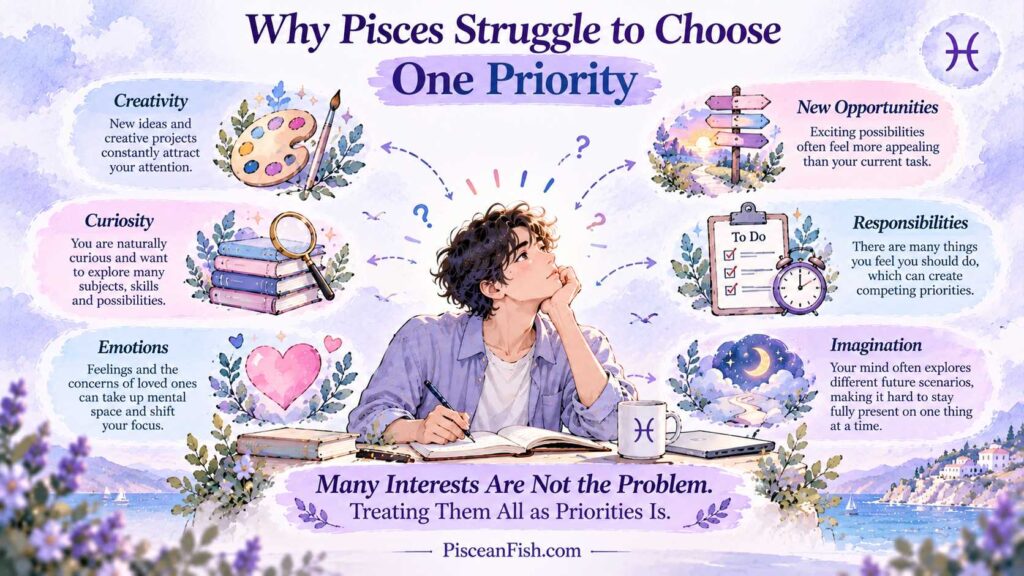
Having multiple interests is not inherently a weakness. Intellectual curiosity, creativity, and a willingness to explore different subjects can lead to valuable discoveries. The difficulty emerges when every interest is treated as an active priority. Attention is limited. Even when several goals are important, they cannot all receive the same depth of concentration at the same moment.
Constantly moving between them also creates a mental cost, each switch requires attention to move away from one subject and become engaged with another. When this happens repeatedly, a person may spend considerable mental energy reorganizing priorities rather than making progress on any single one. This can create a frustrating contradiction. There may be plenty of enthusiasm, ideas, and ambition, yet the visible results do not reflect the amount of mental effort involved.
For someone who identifies with Pisces, the solution is not necessarily to eliminate interests or choose a single passion for life. It is to distinguish between having many interests and actively pursuing many interests at once. An interest can remain valuable without becoming an immediate responsibility. A new possibility can be worth exploring without automatically taking priority over an existing commitment.
Learning to make these distinctions protects curiosity from turning into constant mental competition.
3. Why a New Possibility Can Compete With an Existing Priority
A new idea can attract attention because it offers novelty, possibility, and a sense of discovery. An existing task, by contrast, may involve repetition, uncertainty, or the less exciting stages of development.
This difference can influence where attention naturally moves. When an idea is new, its possibilities remain largely unexplored. The mind can imagine what it might become without yet confronting all the practical limitations involved. An established commitment has fewer unknowns and may require patient work rather than exciting discovery.
As a result, the new possibility can temporarily seem more compelling than the existing priority. This does not mean the original commitment was a mistake. Nor does it mean the new idea is necessarily better. The two may simply offer different kinds of psychological rewards.
For Pisces who recognize themselves in this pattern, an important question is whether a new interest genuinely deserves a change in direction or merely feels more attractive because it is new.
That distinction matters because repeatedly changing priorities can prevent a worthwhile idea from receiving enough sustained attention to develop. Before changing direction, examine the reason for the change. Has new information revealed a genuine problem with the current path? Or has the appeal of novelty made the current path seem less interesting than it did before? The answers may lead to different decisions.
4. Emotional Concerns Can Compete With the Task at Hand
Attention is not influenced by interests alone. Emotional concerns can also occupy mental space. Unresolved disappointment, uncertainty about a decision, concerns about relationships, or the desire to understand a difficult experience can continue demanding attention even when a person is trying to concentrate on something unrelated.
This is sometimes described as mental preoccupation, part of the mind remains occupied by an issue that has not yet been resolved. Astrological descriptions frequently associate this situation of Pisces with emotional sensitivity.
However, emotional preoccupation is a human experience, not something exclusive to a zodiac sign. When emotions compete with a task, simply demanding greater discipline may not be enough. It can help to acknowledge the concern and determine whether it requires action, reflection, or acceptance of uncertainty.
For example, a person may need to make a decision, communicate a boundary, or recognize that an outcome cannot currently be controlled. Once the concern has been identified more clearly, it may become easier to return attention to the chosen activity.
The goal is not to suppress emotions or solve every emotional question before doing meaningful work. That would make concentration dependent on achieving perfect inner calm.
Instead, the aim is to prevent every unresolved feeling from becoming an instruction to abandon the task at hand.
5. The Difference Between Changing Direction and Losing Focus
Not every change of interest represents a concentration problem. Sometimes a person discovers that an existing goal no longer fits their circumstances, values, or abilities. Changing direction can be a thoughtful response to new information rather than evidence of inconsistency.
The challenge is distinguishing deliberate change from repeated reconsideration that never leads to a clear decision. A deliberate change usually has a reason that can be explained. It may involve new evidence, changed circumstances, a more realistic understanding of the goal, or a meaningful shift in priorities.
Repeated reconsideration, however, may involve cycling through the same questions without obtaining new information. The person returns to the same alternatives, experiences temporary certainty, and then begins questioning the decision again.
This cycle consumes attention because the decision remains mentally open. Pisces who struggle with focus can benefit from establishing a simple rule that do not reopen a decision merely because uncertainty has returned.
Uncertainty does not automatically mean the decision is wrong. Important choices often remain uncertain even after careful consideration.
When a decision is reasonable and the circumstances have not materially changed, continuing with it for an agreed period can provide useful evidence. Progress can then be evaluated using actual results rather than every passing feeling of doubt.
Flexibility remains important, but flexibility works best when it is guided by judgment rather than constant reconsideration.
6. How Unfinished Tasks Keep Dividing Attention
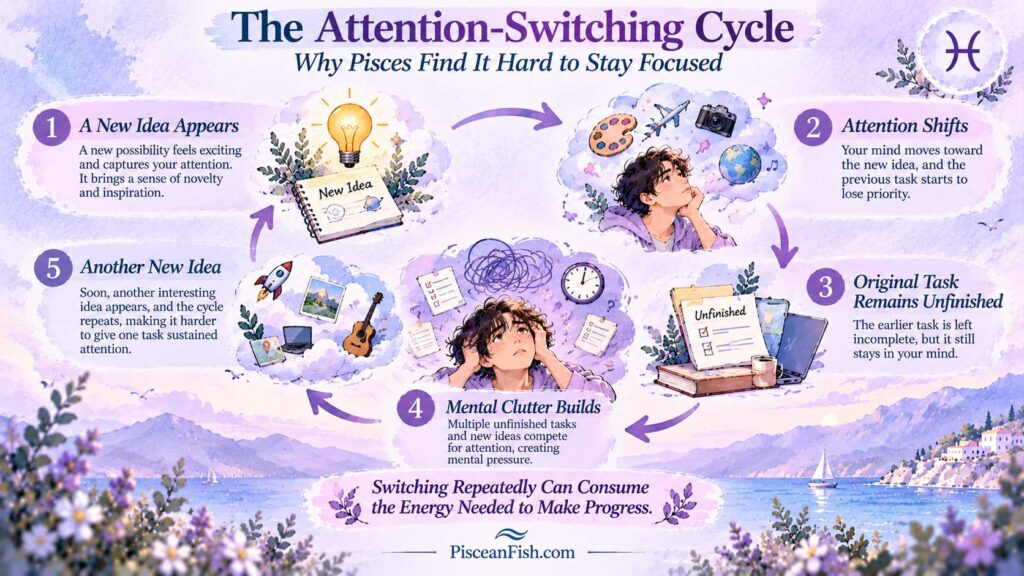
An unfinished task can remain mentally active because it represents something that still needs a decision, action, or conclusion. When several responsibilities remain incomplete, they can compete for attention even when only one is being addressed.
The difficulty becomes greater when unfinished tasks are poorly defined. A vague responsibility does not provide a clear endpoint, so the mind may repeatedly return to it without knowing exactly what needs to happen next.
One useful approach is to define completion in concrete terms. Instead of treating a large project as one enormous obligation, identify a meaningful unit of progress. This might involve completing a specific section, making one necessary decision, or resolving a clearly defined part of the work.
The purpose is not to break every activity into trivial steps. It is to make the current priority sufficiently clear that attention has somewhere definite to go. It also helps to record tasks that cannot be completed immediately. Writing down the next action and when it will be reconsidered can reduce the need to keep mentally rehearsing it. A reliable external record allows the mind to concentrate on the present task without pretending that other responsibilities do not exist.
For those experiencing Pisces lack focus, this distinction can be particularly useful if the goal is not to remember everything simultaneously, but to trust a system that keeps important responsibilities visible.
7. How Pisces Can Improve Focus Without Losing Curiosity
Improving concentration does not require abandoning creativity, spontaneity, or the desire to explore. It requires creating boundaries around attention so that these qualities can be used more deliberately. The following practices can help.
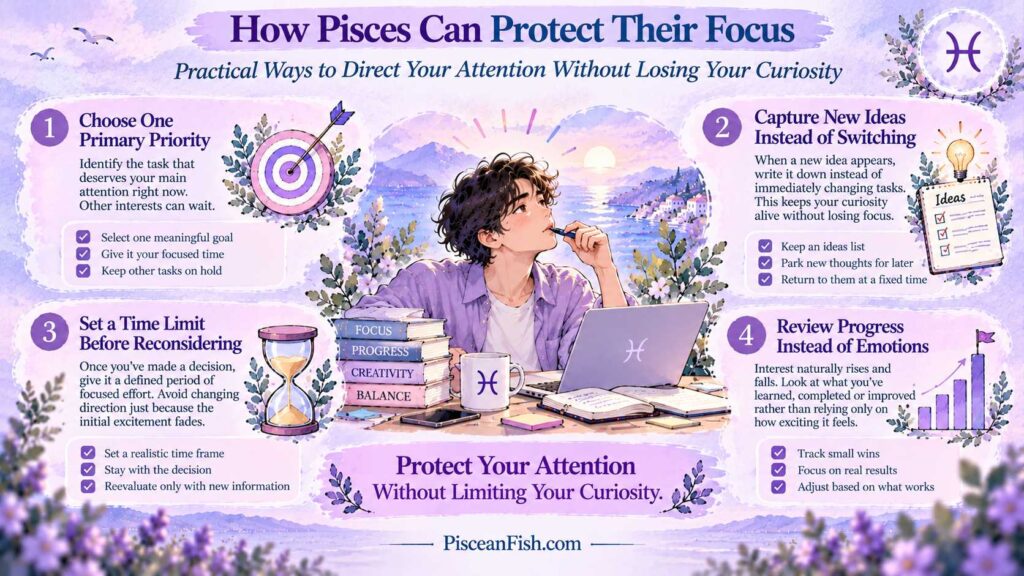
Choose one primary priority
At the beginning of a work period, identify the task that deserves the greatest attention. Other responsibilities may remain important, but they do not all need to be equally active. A primary priority creates a reference point for decisions about where attention should go next.
Keep a list of competing ideas
When a new idea appears, record it instead of immediately switching activities. This acknowledges the idea without allowing every new possibility to interrupt the current commitment.
Review the list at a designated time. Some ideas may deserve further exploration; others may lose their appeal once they are no longer competing for immediate attention.
Establish a period for staying with a decision
Once a reasonable decision has been made, give it a defined period of focused effort before reconsidering it. The appropriate period depends on the task. The important principle is to avoid changing direction simply because the initial excitement has faded or uncertainty has appeared. Reconsider sooner when meaningful new information or a genuine problem requires it.
Reduce unnecessary switching
Whenever possible, group similar tasks together and limit avoidable interruptions. Repeatedly shifting between unrelated activities can make sustained concentration more difficult. The aim is not to create a rigid schedule for every minute. It is to give important work enough uninterrupted space to develop.
Review progress rather than mental excitement
Interest naturally fluctuates. A task that feels meaningful one day may feel ordinary the next. Instead of using enthusiasm as the only measure of whether a task deserves attention, examine what has been learned, completed, or improved. This encourages decisions based on evidence rather than temporary changes in mood.
Leave room for exploration
A system that allows no freedom can become difficult to maintain. Reserve some time for curiosity, experimentation, and new ideas. When exploration has a legitimate place, it becomes easier to protect focused work without feeling that every alternative must be ignored forever.
The purpose of these practices is not perfect concentration. It is a more intentional relationship with attention.
8. When Lack of Focus May Need a Different Explanation
It is important not to attribute every concentration difficulty to Pisces characteristics. Trouble maintaining attention can have many possible explanations, including insufficient sleep, stress, anxiety, low mood, an overwhelming workload, environmental distractions, or attention-related conditions.
If concentration difficulties are persistent, occur across several areas of life, or significantly interfere with responsibilities, it may be worth discussing them with a qualified healthcare professional.
This is particularly relevant when the problem is new, worsening, or accompanied by other concerning changes. Astrology can offer a language for personal reflection, but it cannot establish the cause of an individual’s attention difficulties.
Understanding the actual circumstances is more useful than assuming that a zodiac sign explains the entire experience. Self-improvement works best when it combines honest reflection with a willingness to consider explanations beyond personality labels.
Sometimes, a lack of focus on one task is not simply a matter of distraction, it may also be a way of managing fear. When a particular project creates anxiety because its outcome is uncertain, a person may shift attention toward other tasks that feel more predictable or manageable. This shift can reduce the immediate emotional pressure associated with the main project because the mind is no longer concentrating entirely on the source of fear.
For example, someone who feels anxious about an important presentation might become absorbed in organizing documents or completing other responsibilities. The presentation has not become less threatening in reality, but the person may temporarily feel less anxious because their attention is occupied elsewhere. In this sense, divided attention can sometimes function as a short-term emotional coping strategy rather than simply reflecting an inability to concentrate.
Conclusion: Focus Is the Ability to Choose What Deserves Your Attention
When people discuss Pisces lack focus, they may overlook the distinction between having a curious mind and allowing every interest to compete for immediate attention. The challenge is not necessarily a shortage of ambition, intelligence, or meaningful ideas. It may be the difficulty of protecting one priority while other possibilities, responsibilities, and emotional concerns remain present.
The answer is not to eliminate curiosity or force yourself to follow one path forever. It is to become more deliberate about when to explore, when to continue, and when to reconsider a decision.
You can appreciate a new idea without pursuing it immediately. You can experience uncertainty without abandoning a reasonable commitment. You can have several meaningful interests without giving all of them equal attention at once.
For Pisces who recognize these patterns, the most useful change may be learning that choosing one thing for now does not mean rejecting everything else. Focus is not about having fewer possibilities. It is about giving the right possibility enough attention to become something real.