

A person can be talented, thoughtful, creative, and capable yet still feel that other people are somehow above them. They may have qualities that others genuinely appreciate, but those qualities do not always influence how they see their own place in the world. Instead, they may quietly assume that other people are more capable, more deserving, or better equipped to succeed.
This is one way to understand the Pisces inferiority mindset, a pattern in which someone struggles to recognize the full value of their abilities because they judge themselves according to standards that do not reflect their actual strengths.
The interesting question is not simply why a Pisces might underestimate their abilities. It is why genuine strengths sometimes fail to change a person’s internal sense of position.
Understanding this distinction reveals a less obvious side of the inferiority mindset and explains why recognizing your abilities can require more than receiving praise or achieving success.
1. Pisces May Judge Their Entire Identity Through One Missing Quality
One reason people develop an inferiority mindset is that they evaluate their entire identity through a narrow definition of what makes someone valuable. Imagine a Pisces who is imaginative, emotionally perceptive, and excellent at understanding complicated situations.
However, they struggle with public speaking. When they enter a room with confident speakers, they may begin to feel less capable than everyone else. Their abilities have not disappeared.
Nevertheless, one weakness becomes the standard against which they judge their entire identity. This happens when a person confuses being less skilled in one area with being less capable overall. Someone can be an excellent listener without being an outstanding speaker. They can be creative without being naturally competitive. They can understand people deeply without having the same social confidence as someone else. These differences do not establish a hierarchy of human ability.
For a person who identifies with Pisces traits, the important distinction is between recognizing a genuine limitation and allowing that limitation to define their entire identity. A weakness describes an area for development, it does not provide a complete description of a person.
2. Their Strengths May Become Invisible Because They Come Naturally
People often underestimate qualities they possess without much conscious effort. For example, someone who naturally notices details, understands subtle changes in a conversation, or connects seemingly unrelated ideas may consider these abilities ordinary. Because they do not experience them as difficult, they may assume that everyone else possesses the same skills.
Meanwhile, they might admire another person’s ability to speak confidently, organize a complicated project, or make quick decisions because those qualities appear impressive and measurable. This creates an unfair comparison.
The person evaluates their own familiar abilities against someone else most visible achievements. Traditional Pisces descriptions frequently emphasize intuition, imagination, and sensitivity. If a person identifies with these qualities, they might overlook their practical value simply because they do not resemble the conventional signs of achievement.
For instance, recognizing tension in a group can help prevent misunderstandings. Imagination can contribute to original solutions. Noticing overlooked details can improve creative or analytical work.
However, these strengths may remain undervalued when someone believes that only obvious accomplishments count. A useful exercise is to identify abilities that other people regularly rely on, even when those abilities feel completely natural to you. Sometimes, what feels ordinary from the inside is genuinely useful from the outside.

3. Pisces May Measure Their Worth Using Someone Else Definition of Success
An inferiority mindset can develop when a person accepts standards that do not reflect their own values. Consider someone who values meaningful work, creativity, personal integrity, and close relationships. They might be reasonably satisfied with their life until they compare themselves with people who prioritize wealth, public recognition, professional status, or rapid achievement.
Suddenly, their own progress appears insufficient. The problem may not be a lack of ability. It may be that they are measuring their lives using a system designed around others priorities. This distinction matters because different strengths produce different outcomes. Leadership, artistic imagination, technical expertise, emotional awareness, and practical judgment do not necessarily lead to the same visible rewards.
Yet people sometimes treat one particular type of achievement as the universal measure of competence. Within a Pisces-inspired self-reflection framework, this can be an opportunity to examine whether personal values have been replaced by borrowed expectations.
4. Their Position in a Group Can Distort Their View of Themselves
People do not evaluate their abilities in isolation. Their sense of competence can change depending on whom they are around. Someone may feel knowledgeable among beginners but inadequate among experienced professionals. They may be confident with close friends but unusually quiet in a group where everyone appears articulate and accomplished.
The surrounding environment changes the qualities that become visible. Suppose a Pisces is particularly good at creative problem-solving. In a group that values quick answers and forceful opinions, their thoughtful approach might receive less attention. They could mistakenly interpret the group’s preferences as evidence that their abilities are inferior.
However, a different environment might value careful reasoning and originality, allowing the same abilities to become much more apparent. This does not mean every uncomfortable environment is wrong or that every person who feels out of place is secretly more capable than others.
Rather, it highlights an important distinction: being less suited to a particular environment is not the same as being less capable as a person. A more accurate assessment considers both the individual’s abilities and the demands of the situation.
Sometimes, growth involves developing new skills. At other times, it involves recognizing that a particular setting rewards only a narrow selection of strengths.
5. Praise May Not Change a Belief That Was Formed Around Different Evidence
Imagine that someone receives positive feedback about their work. They hear that their ideas are original and their contribution is valuable. Nevertheless, they assume the other person is simply being polite.
Now imagine that the same person makes a small mistake. They immediately treat it as evidence that they were never particularly capable. Notice the imbalance, positive information is dismissed, while negative information is accepted as decisive.
This pattern can maintain an inferiority mindset even when real strengths are repeatedly demonstrated. The problem is not necessarily that the person lacks evidence of their abilities. Instead, they may be using different standards to evaluate different kinds of evidence.
A compliment is treated as an exception. A mistake becomes a verdict. Over time, this approach prevents experience from producing a balanced understanding of the self. A more useful response is to evaluate feedback according to its substance. If someone praises a specific contribution, consider what made that contribution effective. If someone identifies a genuine weakness, examine what can be learned from it. Neither piece of information needs to determine your entire identity.
6. Being Capable Does Not Mean Being Equally Capable in Every Situation
Another source of inferiority is the expectation that genuine ability should appear consistently across different circumstances. A person might perform exceptionally well when working independently but struggle when required to make decisions under pressure. They might communicate thoughtfully in writing but find spontaneous conversations difficult.
When their performance changes, they may conclude that their strengths were never real. In reality, human abilities are influenced by experience, preparation, environment, available resources, and the demands of a particular task. Competence is rarely a single quality that appears identically everywhere.
A Pisces who identifies with creativity or emotional awareness may still need to develop organization, assertiveness, technical knowledge, or decision-making skills. Recognizing these gaps does not invalidate their existing strengths.
In fact, acknowledging uneven abilities is part of understanding oneself accurately. The goal is not to prove that you are secretly better at everything than you think. It is to develop a realistic picture of what you do well, what requires improvement, and what you have not yet had an opportunity to learn. That picture is more useful than either exaggerated self-criticism or unrealistic self-praise.
7. The Inferiority Mindset Can Become a Habit of Ranking People
Sometimes, a person begins to evaluate ordinary interactions through an invisible ranking system. Who is more intelligent? Who is more mature? Who is more talented? Who deserves greater respect? Once this habit becomes familiar, almost any situation can become an opportunity to feel inferior.
Someone else tells an interesting story, and their communication skills suddenly seem superior. A colleague finishes a project quickly, and their speed becomes evidence of greater competence. A friend makes a confident decision, and their certainty is mistaken for better judgment.
The problem is not noticing other people’s strengths. That can be valuable and motivating. The difficulty arises when another person’s strength automatically becomes evidence against your own. Two people can possess different abilities without occupying fixed positions on a universal ladder of worth. One person may be more experienced in business, while another has greater artistic skill. One may make decisions quickly, while another considers consequences more thoroughly.
These differences are not always comparable, and even when they are, they do not establish overall human superiority. For someone who repeatedly experiences this pattern, a helpful question is:
What have I actually learned about myself from this situation, apart from the fact that another person has a strength? This question turns attention away from ranking and toward understanding.
8. How to Develop a More Accurate View of Your Strengths
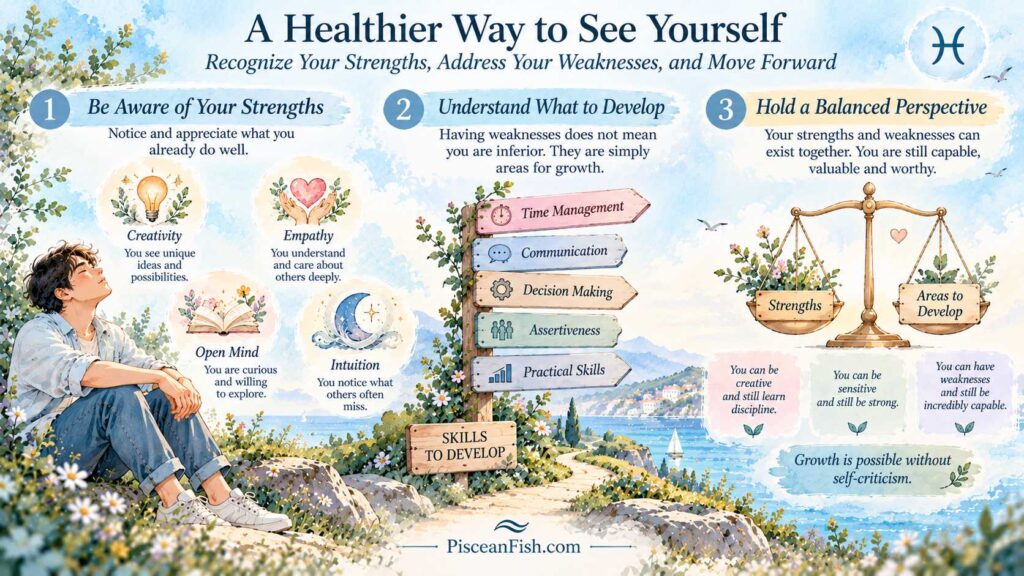
Changing an inferiority mindset does not require pretending that weaknesses do not exist. It requires developing a more balanced method of evaluating yourself.
Separate evidence from interpretation
Suppose you struggle during a presentation. The evidence is that the presentation did not go as planned. The interpretation might be that you are incapable, unintelligent, or less talented than everyone else.
Only the first statement directly describes the event. When you notice a negative conclusion, ask what the situation actually demonstrates and what you might be assuming beyond the available evidence.
Record the value of your contributions
Instead of creating a general list of positive adjectives, record specific examples of your abilities in action. Perhaps you solved a problem that had confused someone else, noticed an important detail, helped a team understand a difficult idea, or completed a task that required patience. Concrete examples provide a clearer picture of competence than vague statements about being good or bad at something.
Identify the skills you genuinely need to develop
Some feelings of inadequacy point toward a real learning opportunity. You may need more experience, better preparation, or additional knowledge. Identify the exact skill involved and make a practical plan to improve it. This approach allows you to address a limitation without turning it into a judgment about your entire identity.
Examine the standards you use
Ask whether you are judging yourself according to a goal you genuinely value or a standard you adopted because other people admire it. You can appreciate someone’s success without deciding that their path is the only valid one.
Allow strengths and weaknesses to coexist
You do not need to eliminate every weakness before acknowledging an ability. You can be a thoughtful person who struggles with assertiveness. You can be creative while learning discipline. You can understand emotions well while still making mistakes in relationships. A realistic self-image makes room for all these facts without allowing one to erase the others.
Conclusion: Your Strengths Do Not Need to Defeat Others Strengths
The Pisces inferiority mindset offers a useful way to explore how people can possess genuine abilities while still perceiving themselves as less capable than others. The underlying issue may involve the standards they use, the qualities they overlook, the environments in which they evaluate themselves, or the way they interpret evidence about their performance.
Recognizing these patterns does not mean that every feeling of inferiority is unfounded. Sometimes, improvement really is necessary. At other times, the judgment is broader than the evidence supports.
The important task is to distinguish between the two. You do not need to be the most articulate person in a room to have valuable ideas. You do not need to excel at every skill to possess meaningful abilities. Nor do you need to turn every difference between yourself and another person into a ranking of personal worth.
If you identify with Pisces, let the symbolism of the sign encourage curiosity about your inner world rather than impose another label on your identity. Your strengths deserve an honest assessment, your limitations deserve practical attention, and neither needs to determine your entire value as a person.