

An Observant Pisces may notice much more about a situation than they choose to discuss. From a slight change in someone’s tone to an unexpected pause during a conversation, small details can capture their attention. While other people may focus on what is being said, Pisces might also pay attention to how something is said, what has changed, and what remains unspoken.
However, noticing something does not necessarily mean they will immediately share it. Sometimes, they prefer to remain quiet, gather more information, and understand the situation before expressing their thoughts. What makes this subject interesting is the difference between noticing and revealing. A person can recognize a detail without confronting someone about it. They can question a situation without making an accusation. Similarly, they can understand that something feels different while still admitting that they do not know the complete story.
For Pisces who recognize themselves in this pattern, understanding the connection between observation, privacy, and communication can create a more balanced approach to relationships and everyday life.
1. Observant Pisces Pay Attention to Small Changes
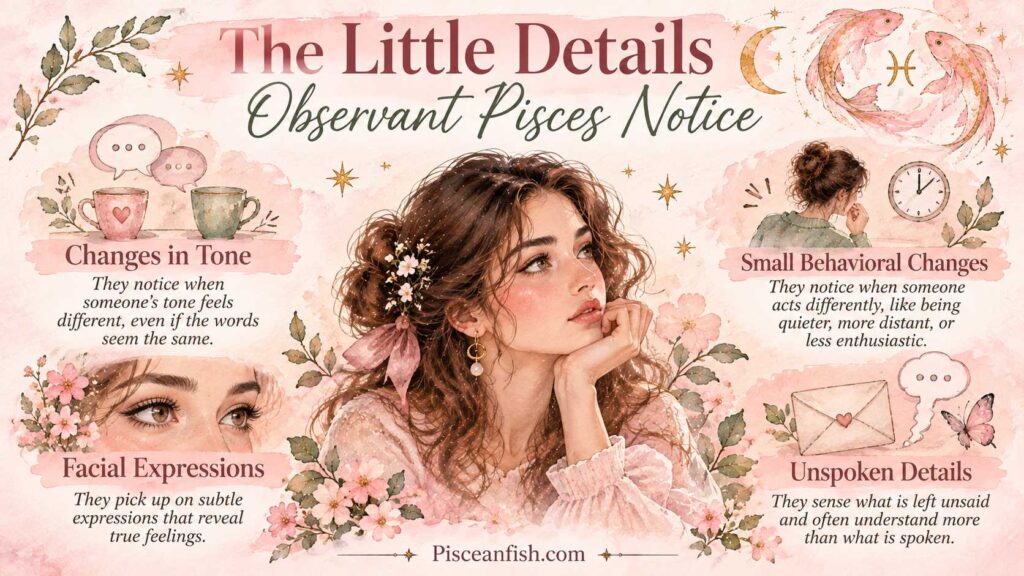
Some people remember the main points of a conversation but overlook the smaller details surrounding it. An observant person, however, may remember that a friend usually speaks enthusiastically about a particular subject but suddenly becomes unusually quiet when it comes up. For an Observant Pisces, these small changes can become noticeable parts of an interaction.
For example, imagine meeting someone who normally greets you warmly. On one particular day, their greeting feels brief, their responses are shorter, and they seem distracted. You might notice these differences even if nobody else mentions them.
The important detail is not necessarily that something is wrong. Perhaps the person is tired, worried about work, or simply having a difficult day. Instead, the observation creates a question: has something changed?
This ability to notice differences can be useful because it encourages attentiveness. Rather than assuming that every interaction is identical, you become more aware of the circumstances surrounding people and situations.
Moreover, paying attention to small details can improve everyday communication. Remembering a person’s preferences, noticing when they need assistance, or recognizing when a conversation requires more care can make interactions more considerate.
However, observation becomes more meaningful when it is combined with patience. A single unusual response is not enough to explain someone’s feelings or intentions. The real skill is noticing a change without immediately deciding what it means.
2. They Listen to What Is Said and What Is Left Unsaid
Conversation involves more than words. Facial expressions, pauses, body language, tone, and the surrounding circumstances can all influence how a message is understood. An observant Pisces may pay attention to these different elements instead of concentrating exclusively on the literal meaning of a sentence.
A person who says they are fine may genuinely prefer privacy. Someone who avoids making plans may have financial difficulties, family responsibilities, or an unpredictable schedule.
Therefore, an observant person should treat these details as information to consider, not proof of a hidden explanation. This approach allows observation to support understanding without turning ordinary interactions into investigations.
3. Why Observant Pisces May Choose to Remain Quiet
Not every observation needs to become a conversation. An Observant Pisces might recognize something interesting about a person or situation but decide that discussing it would not be helpful at that moment. There can be several reasons for this.
First, they may want to understand the situation more clearly before speaking. An initial impression can change when additional information becomes available. Remaining quiet gives them time to consider what they have actually noticed.
Second, they may prefer to avoid unnecessary embarrassment or conflict. Pointing out every inconsistency, change in behavior, or awkward moment can make ordinary relationships uncomfortable.
For example, imagine noticing that a colleague appears nervous during a meeting. Announcing this observation in front of everyone would probably be unhelpful. Offering support privately, if appropriate, may be more considerate.
Third, some people simply value privacy. They do not feel obligated to explain every thought that crosses their mind.
However, silence is not always a sign of wisdom or emotional maturity. Sometimes, a person remains quiet because they fear disagreement, struggle to express themselves, or worry that their observations might be incorrect. Consequently, it is useful to understand the reason behind your silence.
Are you choosing not to speak because the situation does not require a response? Or are you avoiding an important conversation because you are afraid of someone’s reaction?
Recognizing this difference can help you become more confident without losing your thoughtful nature.
4. They May Notice Patterns Rather Than Isolated Incidents
One unusual interaction can be misleading. Repeated behavior, however, may provide more useful information. An observant person might notice that someone frequently makes promises but rarely follows through. Another person may consistently show up when help is needed, even though they are not particularly expressive. Over time, these repeated experiences can influence how we understand a relationship.
Pisces who identify with a reflective and attentive personality, recognizing patterns can be a useful way to move beyond first impressions.
Consider the difference between these two situations:- A friend cancels one meeting because of an unexpected problem. And a friend repeatedly cancels plans without communicating or making an effort to reschedule.
Both situations involve cancelled plans, but the broader circumstances are different. Therefore, it is more reasonable to evaluate a relationship through consistent behavior than through a single disappointing experience.
Moreover, patterns can reveal positive qualities as well. You might notice who respects your time, who listens when you speak, and who offers support without expecting something in return. This kind of observation encourages appreciation as well as caution.
However, even repeated behavior should be considered in context. People make mistakes, experience difficult periods, and change over time. The purpose of noticing patterns is not to permanently label people. It is to make more informed decisions about communication, expectations, and trust.

5. Why They Do Not Always Share Their First Impressions
An observant person may have an immediate impression of a situation but still choose not to express it. This is particularly important because first impressions are not always accurate. You might meet someone who appears distant, only to discover later that they are shy or uncomfortable in unfamiliar environments. Similarly, a confident person may initially seem reliable, but their actual behavior over time may provide a more complete picture.
An Observant Pisces can benefit from allowing impressions to develop rather than treating the first interpretation as a final conclusion. Furthermore, keeping an observation private can sometimes prevent unnecessary misunderstandings. Not every thought needs to be shared immediately, particularly when it concerns another person’s character or intentions.
However, there is a difference between thoughtful privacy and suppressing every concern. If a repeated behavior affects your wellbeing, responsibilities, or relationship, communicating about it may be necessary.
You can express what you observed without claiming to know another person’s motives. For example, “I noticed that our plans have changed several times recently. Is there a better way for us to arrange things?”
This statement focuses on observable behavior rather than making an accusation. As a result, the conversation becomes more constructive and gives the other person an opportunity to respond.
6. When Observation Becomes Over interpretation
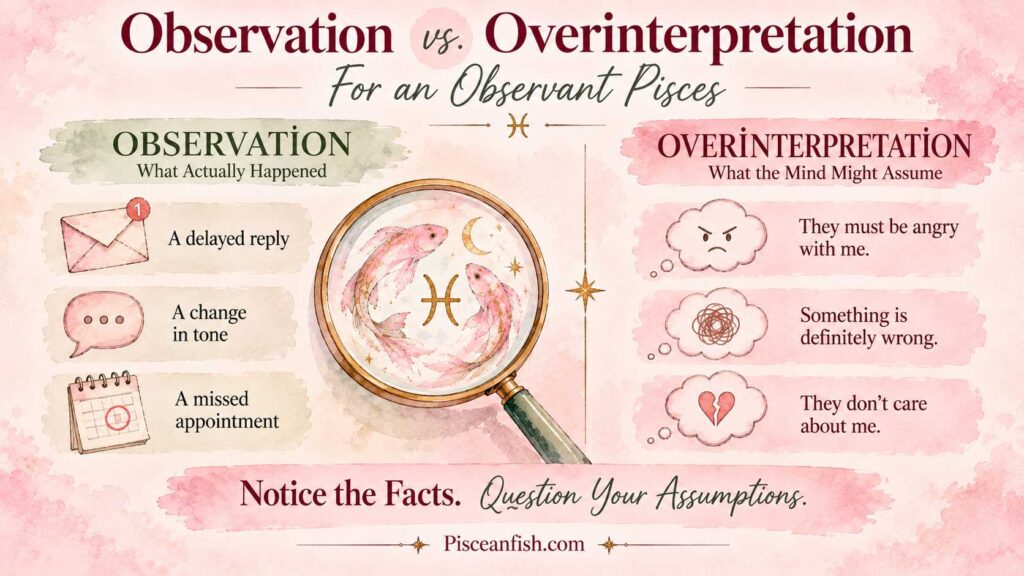
Being attentive can be useful, but paying attention to every detail can sometimes become exhausting. A delayed message, a brief reply, or an unfamiliar expression may create questions that have no immediate answers.
For example, someone might send a shorter message than usual. An observant person may notice the difference and begin considering several explanations. Perhaps the person is upset. Perhaps they are busy. Perhaps nothing has changed at all.
The difficulty begins when possibilities gradually become treated as facts. This is where observation can turn into overinterpretation.
For Pisces who already spend considerable time reflecting on social experiences, it may be helpful to separate three things:
What you observed: A friend replied to your message later than usual.
What you interpreted: Your friend may be upset with you.
What you actually know: The reply was delayed. The reason is still unknown.
This simple distinction can prevent unnecessary emotional conclusions. Instead of repeatedly analyzing a situation, ask yourself whether you have enough evidence to reach a conclusion. If the answer is no, allow the uncertainty to remain. You do not need to solve every unanswered question immediately.
In addition, redirecting your attention toward your own activities can help prevent minor observations from consuming an entire day. Observation should make life clearer, not turn every interaction into a source of worry.
7. Their Observant Nature Can Help Them Recognize Their Own Needs
One interesting aspect of observation is that it can be directed inward as well as outward. People often spend considerable time noticing how others behave while paying much less attention to their own reactions.
However, understanding yourself requires the same willingness to notice small changes. For example, you might recognize that you feel unusually tired after certain conversations. You may notice that you repeatedly agree to requests even when your schedule is already full.
Perhaps you feel comfortable expressing your opinions with some people but become unusually hesitant around others. These observations can provide valuable information about your preferences, habits, and personal boundaries. Rather than criticizing yourself, approach these patterns with curiosity.
Ask yourself:- What situations make me feel comfortable expressing my thoughts? When do I agree with others despite having a different opinion? Which activities leave me feeling satisfied, and which consistently drain my energy? Am I remaining quiet because I prefer privacy, or because I am afraid to disagree?
The answers may help you understand yourself more clearly.
Furthermore, this kind of self-observation can support practical changes. If you notice that you frequently overcommit, you can begin giving yourself more time before agreeing to requests.
If you realize that certain conversations leave you uncomfortable, you can consider communicating your preferences more directly. In this way, observation becomes a tool for personal development rather than simply a way to understand other people.
8. How Observant Pisces Can Use This Quality Wisely
The goal is not to become more suspicious, analyze every conversation, or discover hidden meanings behind ordinary behavior. Instead, the goal is to use attention in ways that improve everyday life.
Here are five practical habits to develop.
1. Notice without judging
Pay attention to what actually happened before deciding why it happened. Give people room to explain themselves.
2. Ask instead of assuming
When something matters, use respectful questions to clarify the situation rather than relying entirely on an impression.
3. Respect personal privacy
Not every detail you notice needs to be discussed. Avoid sharing sensitive observations that could embarrass or harm someone.
4. Give your mind a stopping point
Once you have considered the available facts, allow yourself to move on. You are not responsible for figuring out every person’s behaviour.
5. Use your attention to appreciate people
Notice kindness, effort, honesty, and small gestures of care. Observation can strengthen relationships when it helps you recognize what others do well.
Ultimately, being observant should help you participate more fully in life. It should not make you feel that you must constantly watch, interpret, or evaluate everything around you.
Final Thoughts: You Can Notice More Without Carrying Everything
An Observant Pisces does not need to reveal every thought, explain every impression, or respond to every detail they notice. There is value in listening carefully, recognizing changes, and taking time to understand a situation. Equally, there is value in accepting that some things remain uncertain and that other people have their own private experiences. Your observations can help you communicate more thoughtfully, recognize consistent behavior, appreciate meaningful relationships, and understand your own needs.
However, you do not have to carry every detail into your thoughts for the rest of the day. Sometimes, the healthiest response is to notice something, consider it fairly, and let the moment pass. Remember that understanding people does not require knowing everything about them. Genuine connection develops through honest communication, mutual respect, and the willingness to accept one another as imperfect human beings.
For Pisces who identify with this observant side of their personality, the real opportunity is to combine attention with compassion, curiosity with reason, and privacy with the courage to speak when something genuinely matters. You can be someone who notices the little things without allowing every little thing to occupy your mind. That is when observation becomes a meaningful part of self-awareness, healthier relationships, and personal growth.