
Learning how Pisces can stay emotionally strong isn’t about becoming colder, tougher, or less caring. For someone who values compassion and meaningful connections, emotional strength can sometimes seem like the opposite of kindness. However, real emotional resilience doesn’t require you to stop caring. It means learning how to care without allowing every difficult experience to overwhelm you.
In traditional astrology, Pisces is often associated with emotional depth, compassion, imagination, and sensitivity. While these qualities are not scientific measures of personality and don’t describe every individual, they can provide a useful framework for self-reflection. The real challenge is balance. You can remain gentle while becoming more resilient. You can listen to someone else’s pain without carrying it for days. You can forgive without repeatedly accepting the same hurt.
Most importantly, you can protect your emotional well-being without losing the kindness that makes your relationships meaningful. So, what does emotional strength actually look like for Pisces?
Emotional Strength Doesn’t Mean Becoming Hard
Many people misunderstand emotional strength. They assume a strong person doesn’t cry, doesn’t get hurt, doesn’t need anyone, and quickly moves on from difficult experiences. In reality, emotional strength can look very different. A resilient person can feel disappointed and still continue. They can experience rejection without deciding that they have no value. They can care about someone while recognizing that the relationship isn’t healthy. They can admit that something hurt without allowing the experience to define their entire identity.
Therefore, emotional strength isn’t the absence of emotions.It is the ability to experience emotions without allowing them to control every decision. For Pisces, this distinction can be especially valuable.
1. Stop Treating Every Emotion as an Emergency
When an emotion feels intense, the mind may naturally want to respond immediately. You might want to send the message, explain yourself, make a decision, withdraw, or demand an answer.
However, intense emotions don’t always require immediate action. Sometimes the strongest response is to pause. Take a walk. Put the phone down. Write your thoughts somewhere private. Give yourself a few hours before responding to an emotionally charged situation. This doesn’t mean ignoring your feelings.
Instead, you’re giving yourself enough space to understand them. Ask, “What am I feeling, and what do I actually need right now?” That small pause can prevent temporary emotions from creating permanent problems.
2. Learn the Difference Between Caring and Carrying
Caring about someone is healthy. Carrying their emotional problems as though they belong to you is different. A Pisces may sometimes feel deeply affected when someone close to them is struggling. They may spend hours thinking about how to help, what to say, or what they could do differently.
Eventually, however, this can become exhausting. You can support someone without becoming responsible for their recovery. You can listen without solving everything. You can offer advice without controlling the outcome. And you can love someone while allowing them to make their own choices. This boundary doesn’t reduce compassion. Instead, it allows compassion to last.
3. Build Emotional Boundaries Before You Need Them
Boundaries are often discussed only after someone has already become exhausted. By then, frustration may have accumulated for weeks or months. A healthier approach is to establish boundaries earlier. For example: Don’t answer every message immediately. Don’t agree to every request. Don’t repeatedly explain decisions that are already clear. Don’t stay in conversations that become disrespectful. Don’t sacrifice sleep and personal responsibilities every time someone needs help.
At first, setting boundaries may feel uncomfortable. Nevertheless, discomfort doesn’t mean you’re doing something wrong. Sometimes it simply means you’re learning a new way of respecting yourself.
4. Don’t Confuse Forgiveness With Forgetting
Forgiveness can be valuable, but it doesn’t require pretending that nothing happened. A Pisces may sometimes understand why another person behaved badly and therefore become willing to forgive them. That’s compassionate.
However, understanding someone’s reasons doesn’t automatically make their behavior acceptable. You can forgive someone and still change how much access they have to your life. You can wish someone well without returning to the same situation. You can release anger without reopening a door that needs to remain closed. In this way, forgiveness can become part of emotional resilience rather than a reason to repeat old patterns.
5. Stop Measuring Your Worth Through Other People’s Behavior
Rejection, criticism, distance, or disappointment can sometimes feel deeply personal. If someone doesn’t respond the way you hoped, it’s tempting to ask: “What’s wrong with me?” But another person’s behavior isn’t a complete measurement of your value. Someone can misunderstand you. Someone can choose a different path. Someone can become distant. Someone can disagree with you. None of these automatically means that you are unworthy.
Therefore, build a stronger internal reference point. Instead of constantly asking: “Do they approve of me?” also ask: “Do I respect the way I’m treating myself?” That shift can gradually strengthen emotional independence.
6. Give Difficult Emotions a Healthy Outlet
Emotions need somewhere to go. If you continually suppress them, they may eventually appear through irritability, exhaustion, withdrawal, or constant overthinking. However, expressing an emotion doesn’t mean acting on every impulse. There is a difference between: feeling anger and using anger to hurt someone. There is also a difference between: feeling sadness and deciding that your life will never improve.
Healthy outlets can include journaling, creative activities, exercise, walking, music, quiet reflection, or talking with someone you trust. The goal isn’t to eliminate difficult emotions.It’s to process them without allowing them to become destructive.

7. Practice Staying Present When Your Mind Wants to Escape
A powerful imagination can be comforting during difficult periods. You might imagine different outcomes, replay memories, create future scenarios, or retreat into an internal world where things feel easier. Sometimes this provides useful perspective.
However, too much mental escape can delay real-life decisions. If you notice yourself spending hours imagining what could happen, bring your attention back to the present. Ask: “What is actually happening right now?” Then ask: “What is one thing I can do about it?” Even a small action can reconnect you with reality.
8. Learn to Handle Disappointment Without Losing Hope
Emotional resilience doesn’t mean avoiding disappointment. Disappointment is part of life. People will sometimes change their minds. Plans will fail. Relationships may end. Opportunities may disappear. Someone you trusted may let you down. The resilient response isn’t: “Nothing matters anymore.” Instead, it is: “This hurts, but it doesn’t have to determine what happens next. ”Allow yourself to acknowledge the disappointment. Then gradually return your attention to what remains possible. Hope becomes stronger when it is realistic.
9. Stop Replaying Every Difficult Conversation
After an uncomfortable conversation, you may find yourself mentally returning to it You remember what you said. Then you imagine what you should have said. Then you consider what the other person might have meant. Eventually, the same conversation has happened dozens of times in your head.
Unfortunately, repetition doesn’t always create closure. Instead, establish a limit. Ask: “Did I learn something useful from this conversation?” If yes, keep the lesson. If not, give yourself permission to stop analyzing it. You don’t have to solve every past moment.
10. Communicate Your Needs Before You Become Resentful
Being emotionally strong doesn’t mean handling everything silently. Sometimes people avoid expressing their needs because they don’t want to appear demanding or create conflict.
However, silence can eventually turn into resentment. If something matters, communicate it calmly. Instead of expecting someone to understand your feelings automatically, give them useful information. For example: “I need some quiet time tonight.” “That comment hurt me.” “I can’t take on another responsibility right now. ”Clear communication is not emotional weakness. In fact, it requires considerable strength.
11. Protect Your Gentle Side With Discernment
Being kind doesn’t mean being available to everyone. This is one of the most important lessons for anyone who wants to remain compassionate without becoming emotionally exhausted. Not everyone deserves the same level of access to your time, attention, and emotional energy. Pay attention to patterns. Does someone respect your boundaries? Do they listen when you speak? Do they support you when you need them? Do they take responsibility for their actions? If the answer is repeatedly no, kindness alone may not repair the relationship.
Sometimes emotional strength means recognizing when compassion needs to be accompanied by distance.
12. Develop the Ability to Walk Away
Walking away isn’t always giving up. Sometimes it is an act of self-respect. You may need to walk away from an argument that is becoming destructive. You may need distance from a relationship that repeatedly drains you. You may need to stop pursuing someone who consistently gives you uncertainty. You may need to abandon an expectation that no longer reflects reality.
The difficult part is accepting that not every ending will provide perfect closure. Nevertheless, you can choose peace even when you don’t have every answer.
13. Create a Personal Emotional Reset Routine
Emotional resilience becomes easier when you have reliable ways to recover. Create a simple routine for difficult days. For example, First, pause instead of reacting immediately. Next, give yourself a few quiet minutes. Then write down what you’re feeling. Afterward, move your body or change your environment. Once you’ve calmed down, reflect on what actually happened. Finally, decide what action is genuinely necessary.This process gives emotions room without allowing them to take over the entire situation.
14. Let Yourself Receive Support
Sometimes emotional strength is misunderstood as complete independence. You don’t have to handle everything alone. Talking to a trusted friend, family member, mentor, counselor, or another supportive person can provide perspective when your thoughts become overwhelming. Asking for support doesn’t make you weak. It simply means you recognize that people aren’t designed to navigate every difficult experience in isolation.
At the same time, choose your support system carefully. You need people who listen without constantly judging, dismissing, or escalating your emotions.

What Emotional Strength Looks Like for Pisces
A healthier version of emotional strength might look like this:
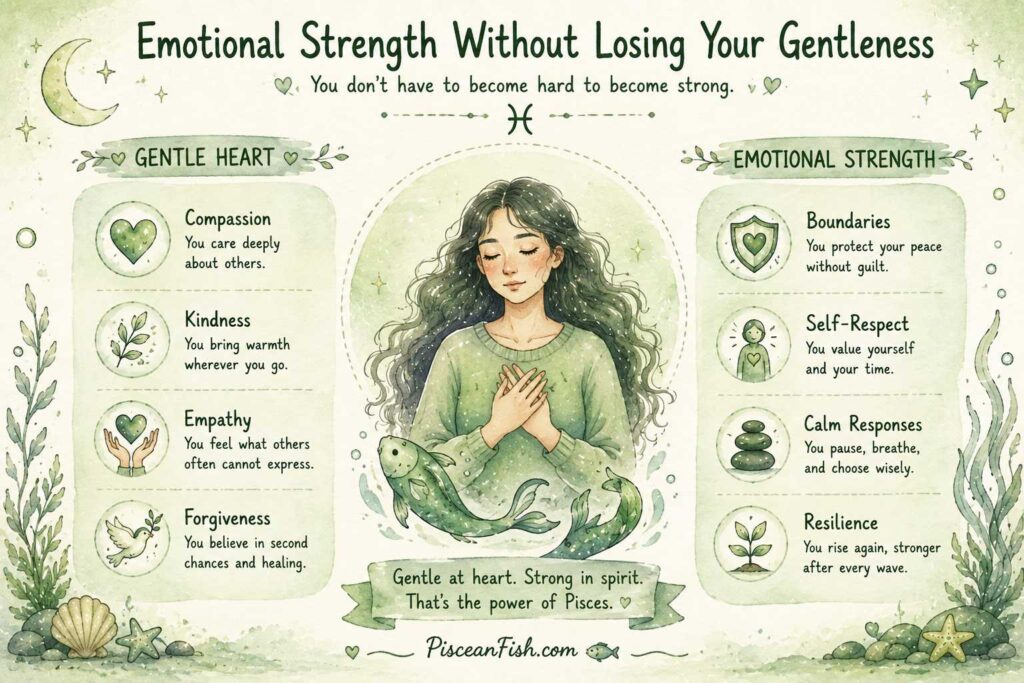
You still care, but you don’t carry everyone.
You still forgive, but you don’t ignore repeated harm.
You still dream, but you take practical action.
You still feel deeply, but you pause before reacting.
You still love strongly, but you maintain your identity.
You still trust your intuition, but you check important decisions against reality.
You still have a gentle heart, but you know when to protect it.
This is not about becoming a different person. It’s about developing enough self-awareness to use your emotional qualities wisely.
Final Thoughts
Staying emotionally strong doesn’t require Pisces to lose their gentle heart. In fact, the goal is almost the opposite. Your kindness becomes more sustainable when you stop giving beyond your limits. Your empathy becomes healthier when you learn that understanding someone’s pain doesn’t make you responsible for removing it. Your emotional depth becomes more useful when reflection eventually leads to clarity and action.
Most importantly, resilience isn’t about never being hurt. You will still experience disappointment. You may still overthink sometimes. You may still miss people, struggle with difficult decisions, or need time to recover after emotionally intense experiences. That’s okay. Strength is what you do after the difficult emotion arrives. You pause instead of reacting. You communicate instead of silently building resentment. You establish boundaries instead of repeatedly abandoning yourself. You learn from the past instead of living inside it. And you protect your peace without becoming emotionally closed. A gentle heart doesn’t need a hard shell. It needs strong boundaries, self-respect, emotional awareness, and the courage to choose what deserves its energy. That is where real emotional resilience begins.